Step Stool Safety Standards Explained: What Weight Ratings, Stability, and OSHA Rules Really Mean
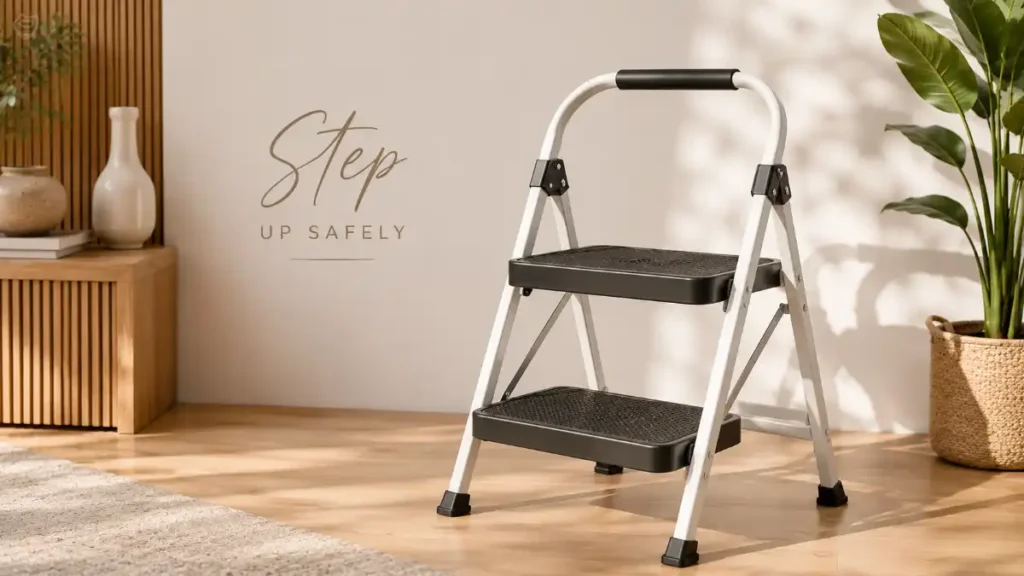
Safety information about step stool products can become confusing because manufacturers, standards organizations, workplace regulators, and consumer-safety agencies address different parts of the problem.
A product can have a published weight rating without being appropriate for every task. A product can look stable but be unsuitable on a particular floor. And an OSHA requirement for workplace equipment should not automatically be presented as a universal legal rule for every household product.
The most useful way to understand step stool safety is to separate standards, regulations, product specifications, and safe-use practices.
What Does a Step Stool Safety Standard Do?
A safety standard establishes technical requirements or guidance for products within its scope.
One important U.S. standard is ANSI ASC A14.11-2018, Safety Requirements for Stepstools. ANSI describes it as covering the safe construction, design, testing, care, and use of applicable wood, metal, plastic, and reinforced-plastic stepstools in various configurations. It includes duty ratings of 200, 225, 250, 300, and 375 pounds.
The standard applies to qualifying stepstools that resemble conventional stepladders as well as certain designs that do not.
This matters because “meets a standard” and “has a high weight rating” are not interchangeable claims.
ANSI Duty Ratings: What the Numbers Tell You
ANSI ASC A14.11-2018 includes these duty ratings:
| Duty rating | Rated load |
| 200 lb | 200 lb |
| 225 lb | 225 lb |
| 250 lb | 250 lb |
| 300 lb | 300 lb |
| 375 lb | 375 lb |
Read More: Step Stool
The rating tells you the applicable load level associated with the standard’s duty-rating framework.
It does not mean that a higher-rated product is automatically more stable, more durable in every environment, or better for every user.
Capacity is only one part of safe selection.
What Counts Toward the Load?
Think in terms of the total load the product is expected to support.
That can include:
- The user’s body weight
- Clothing or equipment
- Tools
- Materials
- Objects being carried
Always follow the manufacturer’s product-specific rating and instructions.
Do Not Apply an Unverified “4× Load” Rule.
One common mistake in online safety content is presenting a universal rule that every step stool must withstand four times its rated load.
That is too broad.
ANSI A14.11 contains specific tests and performance requirements, but the public description of the standard does not establish a simple universal consumer rule that every applicable stool must merely be “tested to four times its rating.” The standard includes multiple types of design and performance considerations rather than one shortcut that can be applied to every product.
The safer editorial approach is to discuss the actual standard and the manufacturer’s documentation rather than inventing a simplified testing formula.
OSHA and Stepstools: Know the Scope
OSHA’s rules apply to covered workplace situations.
Under OSHA 1910.21, a “stepstool” has a specific regulatory definition: it is a self-supporting, portable ladder with flat steps and side rails, fixed height, no pail shelf, and no more than 32 inches in overall height to the top cap, although side rails can extend above the top cap.
That is a workplace regulatory definition. It should not be rewritten as a universal statement that every consumer step stool in every country must be no more than 32 inches tall.
OSHA Stepstool Dimensions
For covered workplace use, OSHA 1910.23 specifies that stepstool steps are spaced 8 to 12 inches apart, measured between step centerlines, and that stepstools have a minimum clear width of 10.5 inches.
The same regulation includes requirements concerning inspection, defects, climbing orientation, hand use, and carrying loads while climbing.
These details are particularly useful when writing workplace safety content because they are regulatory requirements within OSHA’s scope rather than generic household recommendations.
Read More: Step Stool
Standards, Regulations, and Manufacturer Instructions Are Different
These three sources of information should not be treated as interchangeable.
Standards
A voluntary consensus standard can establish technical requirements for products within its scope.
Regulations
A government regulation can establish legally enforceable requirements for covered situations.
Manufacturer Instructions
Product-specific instructions explain how a particular model is intended to be assembled, positioned, loaded, maintained, and used.
A strong safety decision considers all applicable information rather than relying on a single label.
Stability Is Different From Weight Capacity
A stool can support its rated load and still be a poor choice for a particular situation.
Stability depends on several interacting factors:
- Base geometry
- Foot condition
- Floor surface
- Product design
- User position
- Load distribution
- Locking mechanisms
- Structural condition
- Movement around the stool
This is why a “higher capacity” label should never be treated as a complete safety assessment.
Why User Position Matters
The center of your body can move outside the product’s stable support area when you lean or reach.
The farther you reach sideways, the more important positioning becomes.
A safer response to an out-of-reach object is generally to descend and reposition the stool rather than stretching farther from the center.
Footing and Floor Conditions Matter
Even a well-designed product depends on the surface beneath it.
Before use:
- Choose a level, firm surface appropriate for the product.
- Make sure the feet are fully supported.
- Remove loose objects from the immediate area.
- Avoid slippery conditions.
- Do not place the stool on boxes, barrels, furniture, or other unstable objects.
- Follow product-specific instructions for flooring and environment.
American Ladder Institute guidance also emphasizes level support, proper setup, anti-slip feet, and avoiding unstable elevated bases.
Folding Mechanisms Need Special Attention
A folding product introduces additional components that must function correctly.
Before climbing:
- Open the product completely.
- Engage the locking mechanism or spreader as instructed.
- Confirm that the product is fully supported.
- Check hinges and joints for visible damage.
- Do not use it if the locking system does not work correctly.
OSHA’s workplace rules specifically require stepladder spreaders or locking devices to securely hold applicable front and back sections in the open position.
Read More: Step Stool
Inspection Is a Safety Control, Not a Formality
Inspection can identify problems before a defective product is used.
Check for:
- Cracks
- Bent rails
- Broken steps
- Loose fasteners
- Damaged feet
- Missing anti-slip components
- Damaged hinges
- Failed locking mechanisms
- Structural deformation
- Unexpected movement
OSHA requires covered workplace ladders to be inspected before initial use in each work shift and requires defective ladders to be tagged or otherwise identified and removed from service until repaired or replaced.
For household users, the manufacturer’s inspection and maintenance instructions should be followed even when OSHA does not apply.
When a Damaged Stool Should Leave Service
Do not keep using a product simply because the defect appears cosmetic.
Remove it from use when damage affects:
- Structural components
- Steps
- Feet
- Locks
- Hinges
- Standing surfaces
- Stability
- Load-bearing components
Do not rely on improvised repairs unless the manufacturer specifically authorizes an appropriate repair procedure.
A damaged stool is a product-condition problem, not something that can be solved by “being more careful.”
Materials Do Not Automatically Determine Safety
ANSI A14.11 covers applicable stepstools made from wood, metal, plastic, and reinforced plastic.
That is important because safety discussions sometimes incorrectly rank materials from “safest” to “least safe.”
In reality, design and construction matter greatly.
Evaluate:
- Structural design
- Connections
- Surface condition
- Feet
- Load rating
- Intended use
- Environmental suitability
- Maintenance
- Product-specific instructions
Material should be one consideration, not the entire decision.
Read More: Step Stool
Current Consumer Safety Evidence: Children’s Tower Recalls
Consumer-safety recalls demonstrate why product-specific checking matters.
In July 2026, the U.S. Consumer Product Safety Commission recalled Boon PIVOT collapsible toddler tower stools because they could tip over during use. CPSC reported 11 instability reports and no reported injuries at the time of the recall; the remedy involved a stabilizing repair part.
CPSC also recalled approximately 91,000 Woodure toddler kitchen tower stools in July 2026 after reports of instability or tip-over incidents and identified both fall and entrapment hazards.
HARPPA’s Nordi toddler tower recall similarly addressed collapse, tip-over, and entrapment hazards.
These examples should not be generalized into a claim that all children’s tower stools are unsafe. Instead, they show why consumers should verify the exact product model and current recall information.
Children’s Tower Stools Need Separate Evaluation
A children’s standing tower is not simply an adult stool with a smaller user.
Children can interact differently with elevated products, including moving against barriers or placing body parts through openings.
When evaluating a children’s tower, consider:
- Age and developmental suitability
- Manufacturer instructions
- Stability
- Guard or enclosure design
- Openings and potential entrapment points
- Assembly quality
- Product recalls
- Supervision requirements
- Storage and access when not supervised
Never ignore a recall notice because the product appears physically intact.
Safe Use: Position Yourself Correctly
A safe setup includes more than the equipment.
When using a ladder-type stepstool:
- Face the product while climbing.
- Maintain a handhold as appropriate.
- Keep your body positioned in accordance with the manufacturer’s instructions.
- Do not carry loads that interfere with balance.
- Do not move the stool while standing on it.
- Descend before repositioning.
- Keep the surrounding area clear.
OSHA specifically requires employees to face ladders when climbing or descending, use at least one hand to grasp the ladder, and avoid carrying objects or loads that could cause loss of balance and a fall.
When a Step Stool Is the Wrong Equipment
Safety sometimes means deciding not to use a stool.
Choose different equipment when:
- The required height exceeds the product’s intended use.
- You need sustained work from an elevated position.
- You need to reach far sideways.
- The floor cannot provide suitable support.
- The task involves substantial force.
- You cannot maintain stable body positioning.
- The load exceeds the product’s rating.
- The product is damaged.
- Workplace rules require another type of access equipment.
The safest access equipment is the one appropriate for the actual task—not simply the one already available.
Read More: Step Stool
A Practical Safety Hierarchy
When evaluating a step stool, use this order:
1. Product suitability
Is the product designed for this task?
2. Height
Does it provide enough elevation without creating excessive reach?
3. Capacity
Is the total load within the manufacturer’s rating?
4. Stability
Is the product appropriate for the surface and task?
5. Condition
Is it free from structural and functional defects?
6. Setup
Is it fully opened, locked, and correctly positioned?
7. User behavior
Can the task be performed without unsafe reaching or carrying?
If any answer is no, stop and correct the problem before climbing.
Frequently Asked Questions
What is the ANSI standard for stepstools?
ANSI ASC A14.11-2018 is titled “Safety Requirements for Stepstools” and covers applicable stepstools in various configurations, including wood, metal, plastic, and reinforced plastic products.
What weight ratings are included in ANSI A14.11?
The standard includes duty ratings of 200, 225, 250, 300, and 375 pounds.
Is OSHA’s 32-inch rule for every step stool?
No. OSHA’s 32-inch definition applies within its workplace regulatory framework and specifically defines what OSHA considers a step stool for that rule. It should not be presented as a universal consumer-product height limit.
What are OSHA’s stepstool step-spacing requirements?
For covered workplace stepstools, OSHA specifies step spacing of 8 to 12 inches between centerlines and a minimum clear width of 10.5 inches.
Does a higher weight rating mean a stool is safer?
Not necessarily. Load capacity and stability are different characteristics. Floor conditions, geometry, feet, construction, user position, and product condition also affect safe use.
Is there a universal four-times-load testing rule?
Do not use a blanket four-times-load statement as a substitute for the actual standard. ANSI A14.11 includes multiple design and performance requirements rather than a single universal shortcut that describes every applicable test.
How often should a step stool be inspected?
For covered workplace use, OSHA requires inspection before initial use in each work shift and additional inspection when necessary. Household users should follow the manufacturer’s inspection and maintenance guidance and inspect the product before use.
What should I do if my stool rocks?
Do not climb it. Check the floor, feet, locking mechanisms, assembly, and structural condition. If the problem cannot be corrected according to the manufacturer’s instructions, remove the product from use.
Are children’s tower stools covered by the same rules as adult stepstools?
Not necessarily. Product category and applicable standards matter. Children’s tower stools can have additional child-specific fall and entrapment considerations, so check the exact product’s instructions and current recall information.
What is the most important step stool safety rule?
Use the product only for its intended purpose, on a suitable surface, within its rated capacity, and in good condition. Never compensate for an unsuitable height or environment by improvising the setup.