
Acacia Wood: Myths, Facts, Pros, Cons, Uses & Care
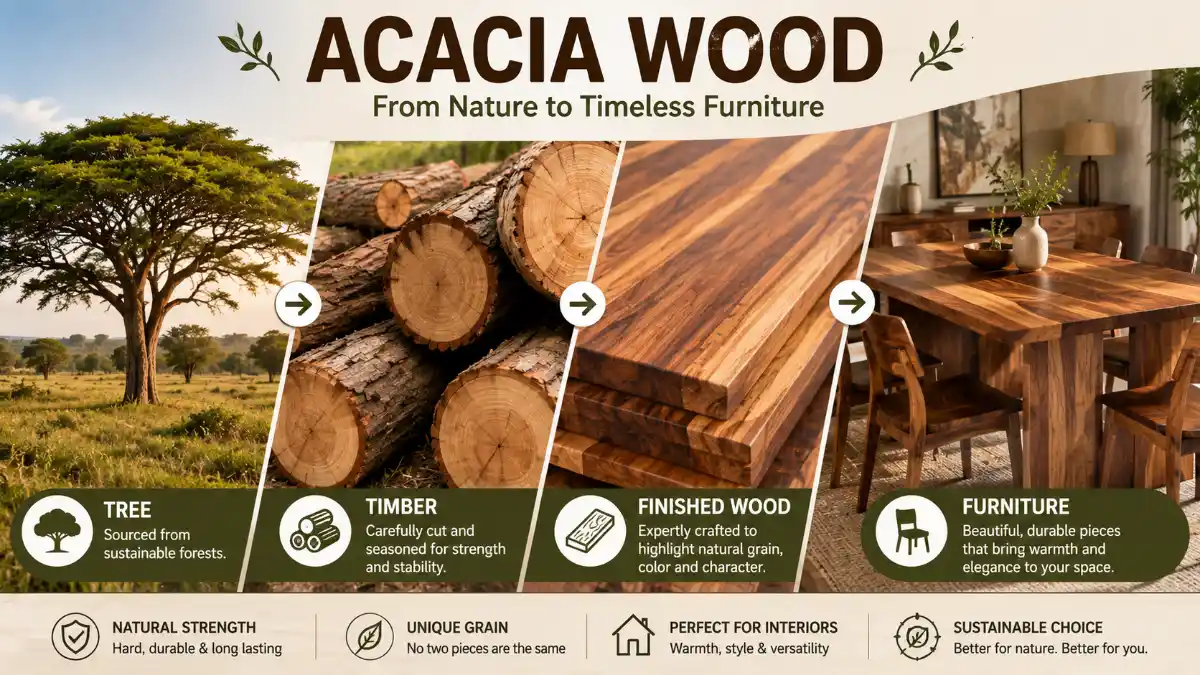
Acacia wood is popular for dining tables, cutting boards, flooring, benches, cabinets, and outdoor furniture because it can combine attractive grain, useful hardness, and relatively good value. But the name can be misleading: acacia wood is not one standardized timber with identical properties. Different species can vary substantially in density, hardness, appearance, and durability.
That matters when you’re comparing acacia timber furniture, choosing material for an outdoor space, or deciding between acacia and teak. The right question is not simply whether acacia wood is “good.” It is whether the particular species, construction, finish, and intended use match your expectations.
This guide separates common myths from practical facts and explains the acacia wood uses, advantages, disadvantages, durability, outdoor performance, care requirements, and buying considerations that actually matter.
What Is Acacia Wood?
Acacia wood refers to timber associated with acacia species, a large and diverse group of trees in the legume family. The botanical picture is more complicated than the label suggests because the plants historically grouped under Acacia have been divided into several genera in modern taxonomy. Kew’s Plants of the World Online recognizes Acacia as a genus while also documenting related taxonomic divisions such as Senegalia and Vachellia.
For consumers, the practical takeaway is simple: “acacia” is a broad commercial label, not a guarantee of one exact wood specification.
Species used for timber products include Acacia mangium and Acacia melanoxylon, among others. Kew notes that Acacia mangium is widely planted in tropical Asia and is used for solid wood products including furniture and cabinetry.
That species variation helps explain why one piece of acacia wood furniture can look or perform differently from another.
Myth: Acacia Wood Is One Specific Type of Timber
Fact: Acacia covers a wide range of species with different physical characteristics.
The commercial label can hide meaningful differences in density, hardness, grain, color, and decay resistance. The Wood Database describes the acacia group as highly variable, ranging from relatively moderate-weight species to exceptionally heavy and hard woods.
For example, Australian blackwood (Acacia melanoxylon) has a reported Janka hardness of about 1,160 lbf, while Acacia mangium is listed at about 1,430 lbf.
So, if you’re evaluating acacia wood durability, the species and construction are more informative than the word “acacia” by itself.
Why Species Matters When Buying
When a retailer provides the botanical species, country or region of production, construction details, and finish information, you have more useful information than you would from a generic “premium acacia” description.
A buyer should be especially cautious when a product listing gives no information beyond “100% acacia.” That does not automatically mean poor quality, but it gives you less information with which to judge the product.
Myth: Acacia timber Is Basically the Same as Teak
Fact: Acacia and teak are different hardwoods with different characteristics, particularly when used outdoors.
The biggest mistake in an acacia wood vs teak comparison is judging the two only by hardness. Some acacia species can be quite hard, but outdoor longevity depends on much more than resistance to dents. Species-specific decay resistance, moisture exposure, construction, finish, drainage, climate, and maintenance all matter.
Teak has a long-standing reputation for outdoor use because its heartwood has strong natural resistance to weathering and decay. Acacia can also perform well outdoors, but performance varies considerably by species and product construction.
| Feature | Acacia Wood | Teak |
| Species consistency | Highly variable | More standardized commercial identity |
| Hardness | Varies substantially by species | Generally moderate to high for furniture |
| Outdoor performance | Good in suitable applications, especially with maintenance | Excellent reputation for demanding outdoor exposure |
| Appearance | Often strong grain and varied warm tones | Usually golden-brown when new, aging toward silver-gray |
| Maintenance | Depends heavily on species, finish, and exposure | Often relatively low-maintenance |
| Price | Often more accessible | Usually more expensive |
| Best buying approach | Check species, construction, and finish | Check grade, construction and teak authenticity |
Read More: Acacia Wood
The comparison therefore should not be reduced to “acacia is cheaper teak.” They are different materials with different trade-offs.
Is Acacia Wood Durable?
Acacia wood durability is one of its strongest selling points, but it should never be treated as a single number.
Some acacia species are dense and hard enough to handle substantial everyday wear. For example, Acacia mangium and Australian blackwood have documented Janka hardness values in the roughly 1,100–1,400 lbf range, while the wider acacia group includes species with substantially different characteristics.
In practical terms, good-quality acacia wood can be a strong choice for dining furniture, tables, benches, cabinetry, and other applications where resistance to ordinary wear matters.
However, hardness does not automatically mean superior outdoor durability. A hard timber can still experience checking, movement, fading, or surface deterioration when repeatedly exposed to sun, rain, moisture changes, and poor drainage.
What Determines Acacia Wood Durability?
Four factors matter particularly:
- Species — different acacias have different density and decay characteristics.
- Construction — well-built joints and properly designed outdoor furniture generally perform better.
- Finish — coatings and oils can influence moisture behavior and appearance.
- Exposure — direct sun, repeated rain, standing water, and temperature swings increase maintenance demands.
This is why a covered patio table and an uncovered garden table can have very different maintenance requirements even if both are made from acacia wood.
Acacia Wood Pros and Cons
The easiest way to judge acacia wood pros and cons is to separate genuine strengths from exaggerated marketing claims.
Advantages of Acacia Wood
Good everyday hardness: Many commercially used acacia species are sufficiently hard for furniture and other products that experience regular contact and wear.
Distinctive appearance: Grain patterns can range from relatively straight to figured or interlocked, with colors that may include golden, reddish, brown, and darker tones depending on species and finish. Australian blackwood, for example, is known for medium golden to reddish-brown coloration and sometimes figured grain.
Wide range of uses: Acacia wood uses include furniture, cabinetry, flooring, tools, boxes, cutting boards, and various solid-wood products. Acacia mangium, in particular, is widely used for furniture and other solid wood applications.
Good value: Acacia can provide an attractive appearance and useful mechanical properties without necessarily carrying the premium associated with some highly sought-after outdoor hardwoods.
Strong visual character: Natural variation means each board or furniture piece can have a somewhat different grain pattern and color.
Disadvantages of Acacia Wood
Performance varies by species: The word “acacia” alone does not tell you enough about durability.
Outdoor maintenance is real: Furniture exposed to weather can fade, develop surface checking, or weather to gray unless maintained or deliberately allowed to age naturally.
Moisture still matters: Acacia wood is not waterproof. Repeated wetting, standing water, poor drainage, or prolonged exposure can eventually cause problems.
Can be heavy: Some acacia species are relatively dense, which can make large furniture pieces difficult to move.
Quality varies between products: The timber may be good while the furniture itself is poorly designed or manufactured.
Read More: Acacia Wood
What Are the Main Acacia Wood Uses?
The versatility of acacia wood is one reason it appears across so many home products.
Acacia Wood Furniture
Acacia wood furniture is commonly used for dining tables, coffee tables, benches, shelves, cabinets, chairs, and bedroom furniture. Its appearance makes it particularly suitable for pieces where the natural grain is intended to remain visible.
For furniture shopping, look beyond the species label. Check whether the piece is solid wood, engineered wood with an acacia veneer, or a combination of materials. Also examine joinery, panel construction, leg attachment, and finish quality.
Kitchen Products
Acacia wood is also used for cutting boards, serving boards, bowls, utensils, and other kitchen products. Its hardness and attractive grain make it visually appealing for these applications.
For food-contact products, however, the manufacturer’s care instructions matter. Do not assume that every acacia product is finished or designed for the same use.
Flooring and Interior Woodwork
Acacia species can also be used for flooring, cabinetry, paneling, and other interior applications. The specific species and manufacturing process determine how the finished product behaves.
Outdoor Furniture
Acacia wood outdoor furniture can work particularly well on covered patios, balconies, porches, and other areas where exposure can be managed.
It can also be used in more exposed locations, but buyers should expect greater maintenance requirements than they might with highly weather-resistant outdoor timbers.
Is Acacia Wood Waterproof?
No. Acacia wood should be considered moisture-resistant to varying degrees, not waterproof.
The distinction is important. A finished table may tolerate accidental spills or occasional rain without immediate damage, but that does not mean it can safely remain wet indefinitely.
Standing water is particularly undesirable. Water can enter joints, end grain, cracks, and unfinished surfaces. Repeated moisture cycling can contribute to swelling, movement, checking, and finish deterioration.
For outdoor pieces, good drainage and airflow are just as important as the finish. Do not allow furniture to sit in puddles or remain covered while wet for extended periods.
Acacia Wood Care: Indoor and Outdoor Maintenance
Proper acacia wood care is less about complicated routines and more about controlling moisture, sunlight, dirt, and unnecessary chemical exposure.
Indoor Acacia Wood Care
For indoor acacia wood furniture:
- Dust regularly with a soft cloth.
- Wipe spills promptly rather than allowing moisture to sit.
- Use a mild cleaner appropriate for the furniture’s finish.
- Avoid excessive water when cleaning.
- Protect the surface from prolonged direct sunlight when possible.
- Keep furniture away from intense heat sources.
- Follow the manufacturer’s instructions before applying oil, wax, or polish.
Do not automatically oil every indoor piece every few months. Some furniture is factory-finished and may not require additional oil. Applying the wrong product can alter the appearance or interfere with an existing finish.
Outdoor Acacia Wood Care
Outdoor acacia wood care should be based on exposure and the manufacturer’s finish recommendations.
A sensible routine is to:
- Remove dirt and debris regularly.
- Clean with mild soap and water when necessary.
- Allow the furniture to dry properly.
- Inspect joints, end grain, and finish for deterioration.
- Use a suitable outdoor finish if the manufacturer recommends one.
- Reduce unnecessary exposure to intense sun and heavy rain when practical.
- Avoid leaving furniture in standing water.
If the furniture develops a natural silver-gray appearance outdoors, that change is primarily a weathering effect. It does not automatically mean the furniture has structurally failed.
How to Buy Good Acacia Wood Furniture
Buying decisions should focus on the product rather than the marketing adjective.
Before purchasing acacia wood furniture, check these points:
1. Ask what species it is.
A named species provides more useful information than simply “acacia.”
2. Confirm whether it is solid wood.
Some products use acacia veneer or mixed materials. That is not necessarily bad, but it should be clearly disclosed.
3. Examine construction.
Look at joints, hardware, table legs, drawer construction, and the way wide panels are assembled.
4. Check the intended environment.
Furniture designed for indoor use should not automatically be treated as outdoor furniture.
5. Read the care instructions.
A product that requires periodic maintenance is not necessarily inferior. It may simply be designed for a particular finish and environment.
6. Look for responsible sourcing information.
Fast growth alone does not prove that a timber product is sustainably sourced. Responsible forestry depends on how the trees are grown, harvested, processed, and managed.
7. Treat price as only one signal.
A higher price can reflect construction, labor, design, finish, hardware, or brand positioning rather than superior timber alone.
Is Acacia Wood Sustainable?
It can be, but the species name by itself does not prove sustainability.
Some acacia species are extensively plantation-grown. Kew describes Acacia mangium as a fast-growing plantation species used at large scale in tropical Asia for pulp and solid wood products.
That makes plantation production relevant to supply, but sustainability is broader than growth rate. Responsible sourcing also involves land management, biodiversity, harvesting practices, legality, processing, and supply-chain transparency.
If sustainability is important to your purchase, look for credible sourcing information or recognized forest-certification documentation rather than assuming that every product labeled acacia wood is automatically sustainable.
Acacia Wood vs Teak: Which Should You Choose?
The answer depends on what you value.
Choose acacia wood when you want attractive natural grain, good everyday durability, a broad range of furniture options, and a potentially lower-cost alternative to premium outdoor hardwoods. It can be especially appealing for indoor furniture and covered outdoor areas.
Choose teak when your priority is demanding outdoor exposure with comparatively low maintenance, and you are willing to pay more for that performance.
The best acacia wood vs teak decision is therefore not “which wood is better?” It is “which wood better matches the environment, maintenance level, appearance, and budget?”
The Bottom Line
Acacia wood is neither a miracle material nor an inferior substitute for teak. It is a broad category of timber with substantial variation between species and products.
Its strengths include attractive grain, useful hardness, versatility, and good value for many applications. Its limitations are equally important: outdoor performance varies, moisture can still cause damage, and maintenance requirements depend heavily on exposure and finish.
For most buyers, the smartest approach is simple: identify the species when possible, inspect the construction, understand the intended use, follow the manufacturer’s care instructions, and do not confuse hardness with weather resistance.
When those factors are matched correctly, acacia wood furniture can be a practical and attractive choice for years of everyday use.
Frequently Asked Questions
Is acacia wood a hardwood or softwood?
Acacia wood is generally classified as hardwood because acacia species are flowering broadleaf trees. However, hardness and density vary substantially between species, so “hardwood” alone does not tell you exactly how a particular product will perform.
Is acacia wood good for furniture?
Yes. Acacia wood can be an excellent furniture material when the species, construction, and finish are appropriate for the intended environment. It is commonly used for tables, benches, cabinets, chairs, shelves, and other solid-wood products.
Is acacia wood good for outdoor furniture?
Acacia wood outdoor furniture can perform well, particularly when exposure and maintenance are properly managed. Covered or partially sheltered areas generally make maintenance easier than completely exposed locations.
How durable is acacia wood?
Acacia wood durability varies by species. Some commercially used acacias are relatively hard and dense, but outdoor durability depends on more than hardness. Species, decay resistance, construction, finish, climate, and exposure all affect service life.
Is acacia wood better than teak?
Not universally. In an acacia wood vs teak comparison, teak generally has the advantage for demanding, fully exposed outdoor use and low-maintenance weather resistance. Acacia can offer better value and attractive performance for many indoor and partially sheltered applications.
Does acacia wood need to be sealed outdoors?
It depends on the species, existing finish, exposure, and manufacturer’s instructions. A suitable outdoor finish can help manage moisture and appearance, but sealing is not a substitute for good drainage, shelter, and routine maintenance.
Does acacia wood turn gray outside?
Yes. Like many outdoor woods, acacia wood can weather and lose its original color when exposed to sunlight and weather. A silver-gray appearance is a common weathering effect and does not automatically indicate structural failure.
Can acacia wood get wet?
Yes, but it should not be treated as waterproof. Occasional moisture is different from prolonged soaking or standing water. Good acacia wood care includes wiping away standing water and allowing outdoor furniture to dry properly.
What are the best acacia wood uses?
Common acacia wood uses include furniture, cabinetry, flooring, cutting boards, serving products, benches, tables, and other solid-wood products. The best application depends on the species and its physical properties.
What should I check before buying acacia wood furniture?
Check the species if available, whether the piece is solid wood or veneer, construction quality, intended indoor or outdoor use, finish, maintenance requirements, and sourcing information. These details tell you considerably more about the product than the word “acacia” alone.






1 thought on “Acacia Wood: Myths, Facts, Pros, Cons, Uses & Care”