Sartorius Muscle Function: How Its Two-Joint Design Shapes Movement
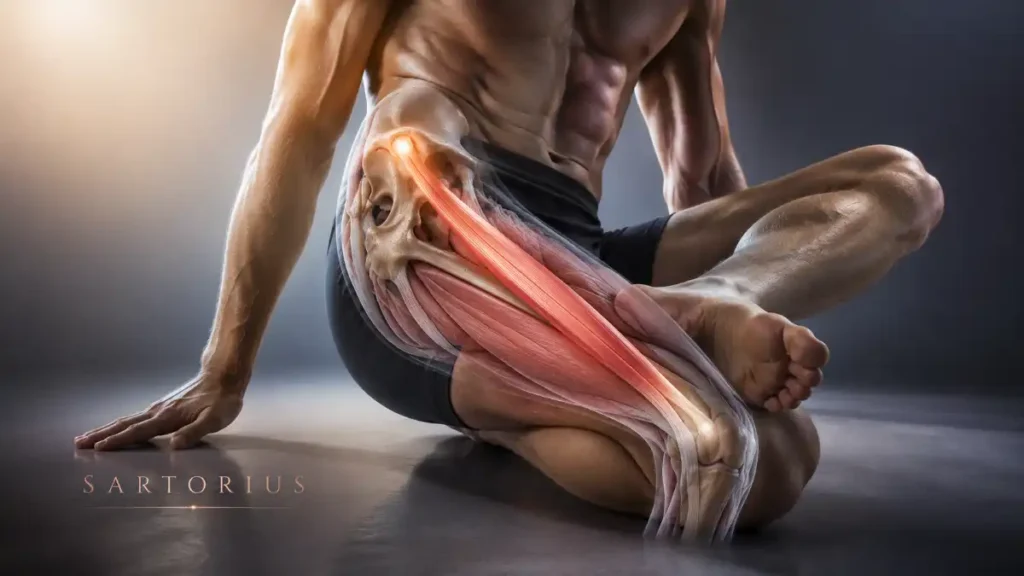
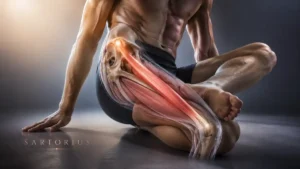
The sartorius muscle is often remembered as the “tailor’s muscle,” but its most interesting feature is not the nickname. It is the way its long fibers cross both the hip and knee and therefore change length as either joint moves.
That two-joint arrangement allows the sartorius to contribute to hip flexion, abduction, and external rotation while also assisting knee flexion and medial rotation of the leg when the knee is flexed. It is not a major powerhouse. Its value lies in where it crosses the joints and how its line of pull fits into coordinated movement.
The Movement Problem the Sartorius Helps Solve
Human movement rarely happens at one joint in isolation.
When you step over an object, climb a stair, reposition your leg while sitting, or move through a rotational stance, the hip and knee continuously change position relative to each other.
A muscle crossing both joints can respond to those combined changes.
The sartorius is therefore best understood as a biarticular contributor to lower-limb positioning, rather than as a muscle responsible for one signature movement.
What the Sartorius Does at the Hip
At the hip, the sartorius assists with three principal actions:
- Flexion
- Abduction
- External rotation
These actions are often remembered with FABER:
Flexion + ABduction + External Rotation
But the acronym is only the beginning.
The important biomechanical point is that these actions arise from the muscle’s line of pull relative to the hip joint.
Hip Flexion
The sartorius crosses the hip anteriorly, allowing it to assist in bringing the thigh forward.
It is not the strongest hip flexor. The iliopsoas is substantially more important for producing powerful hip-flexion force.
The sartorius instead contributes to hip flexion while simultaneously pulling the thigh laterally and externally rotating it.
Hip Abduction
Because of its oblique orientation, the muscle can also assist in moving the thigh away from the body’s midline.
This contribution occurs alongside stronger abductors such as the gluteus medius and gluteus minimus.
Hip External Rotation
The sartorius also contributes to lateral or external rotation of the thigh.
This is particularly important when the hip is already flexed, because rotation changes the orientation of the entire lower limb and affects how the knee and foot are positioned.
What It Does at the Knee
The sartorius crosses the knee and attaches to the medial proximal tibia.
At the knee, it contributes to:
- Flexion
- Medial rotation of the leg when the knee is flexed
The second action is easiest to understand when the knee is bent because the knee permits greater rotational movement in flexion.
This means the same muscle can influence the orientation of the thigh at the hip and the orientation of the lower leg at the knee.
That is the key to understanding its functional identity.
Read More: Sartorius Muscle
Why Crossing Two Joints Changes the Mechanics
A single-joint muscle experiences changes in length primarily as that joint moves.
A biarticular muscle is different.
For the sartorius, hip and knee position both influence muscle length. Moving the hip one way can lengthen the muscle, while moving the knee another way can change its length further.
This creates a constantly changing mechanical situation during movement.
A Simple Example
Imagine moving from standing into a seated position.
Your hip flexes and your knee flexes. The sartorius participates in both regions of movement, but it is not working alone.
Now imagine moving one leg outward and rotating it while the hip remains flexed.
The combination changes the muscle’s line of action and length again.
This is why the sartorius should be understood as part of a movement system, not as an isolated lever.
The Cross-Legged Position
The traditional “tailor’s position” is a useful demonstration because it combines several of the sartorius’ actions.
To bring one leg into a cross-legged posture, the hip can move into:
- Flexion
- Abduction
- External rotation
while the knee flexes.
The sartorius contributes to this combination.
But it would be inaccurate to say that the muscle creates the posture by itself. Numerous muscles coordinate to produce, stabilize, and control the position.
The sartorius is simply one muscle whose line of pull fits particularly well into the movement pattern.
Sartorius Muscle Function During Walking
Walking is not a “sartorius exercise.”
The major forces involved in walking are distributed across the hip, knee, and ankle musculature.
The sartorius may contribute to positioning and coordination of the limb, particularly as the hip and knee move through changing angles.
Its role is therefore better described as supporting movement coordination rather than driving the entire gait cycle.
This distinction prevents a common misconception: a muscle can be functionally important without being the primary generator of force.
Stair Climbing and Stepping
Stair climbing requires substantial work from the hip and knee extensors, especially the gluteal muscles and quadriceps.
The sartorius is not a major power source for pushing the body upward.
Its contribution is more closely related to positioning the limb as the hip and knee change angle.
For example, lifting the foot onto a step requires hip flexion and knee movement before the larger extensor muscles produce the force needed to raise the body.
The sartorius can participate in this positioning phase without being the muscle responsible for the majority of the mechanical work.
Read More: Sartorius Muscle
Running, Cutting, and Rapid Direction Changes
High-speed sports introduce a different challenge.
During sprinting, cutting, kicking, and other rapid movements, the hip and knee can change position quickly. Muscles that cross two joints must accommodate these changing positions while coordinating with larger force-producing muscles.
The sartorius can therefore be involved in such movements, but it would be misleading to claim that its two-joint structure alone makes it uniquely injury-prone.
Injury risk depends on factors such as:
- Load
- Speed
- Fatigue
- Training history
- Tissue capacity
- Previous injury
- Movement demands
Its anatomy is relevant, but anatomy alone does not determine injury.
Sartorius vs. Rectus Femoris
The sartorius is sometimes confused with rectus femoris because both cross the hip and knee.
Their functions are very different.
| Feature | Sartorius | Rectus femoris |
| Hip | Flexion, abduction, external rotation | Flexion |
| Knee | Flexion; assists medial rotation when flexed | Extension |
| Course | Diagonal across thigh | More vertically down anterior thigh |
| Muscle group | Anterior thigh | Quadriceps |
| Major functional role | Limb positioning | Powerful knee extension |
Read More: Sartorius Muscle
This is an important comparison because both are biarticular but contribute to opposite actions at the knee.
Sartorius vs. Hamstrings
The sartorius also interacts functionally with the hamstrings, particularly during knee flexion.
The hamstrings include muscles such as semitendinosus and semimembranosus that cross the hip and knee. They contribute to hip extension and knee flexion.
The sartorius, by contrast, contributes to hip flexion and knee flexion.
So both can assist knee flexion while producing opposing effects at the hip.
That difference matters during coordinated movement.
Sartorius vs. Gracilis and Semitendinosus
These three muscles share the pes anserinus.
| Muscle | Hip contribution | Knee contribution | Shared feature |
| Sartorius | Flexion, abduction, external rotation | Flexion, medial rotation when flexed | Pes anserinus |
| Gracilis | Adduction | Flexion, medial rotation | Pes anserinus |
| Semitendinosus | Extension | Flexion, medial rotation | Pes anserinus |
Read More: Sartorius Muscle
The shared insertion does not mean they perform the same movement.
Instead, their different proximal courses give them different lines of pull while allowing them to influence the same region of the knee.
Does the Sartorius Need to Be Trained in Isolation?
Usually, no.
For general fitness, there is little reason to build a program around isolating the sartorius.
Compound exercises such as:
- Lunges
- Step-ups
- Squats
- Controlled single-leg movements
involve many muscles and can develop the broader hip and thigh capacity required for everyday movement.
The sartorius will participate according to the movement and joint positions involved.
What About “Sartorius-Specific” Exercises?
Exercises marketed as sartorius-specific should be treated cautiously.
A movement can increase sartorius activity without making it the only or even the primary muscle responsible for the exercise.
The more useful question is:
What movement capacity am I trying to improve?
For general fitness, that may mean hip strength, knee control, balance, or single-leg coordination rather than isolated sartorius strength.
For rehabilitation, exercise selection should be based on the diagnosed problem and the person’s current tolerance.
How Joint Position Changes Sartorius Function
One of the most useful ways to understand the muscle is to think about joint position.
Because it crosses two joints, changing the position of either joint affects the muscle’s length and leverage.
For example:
- Hip extension can lengthen the sartorius at the proximal joint.
- Knee extension can lengthen it at the distal joint.
- Hip flexion can shorten it proximally.
- Knee flexion can shorten it distally.
The exact mechanical effect depends on the simultaneous position of both joints.
This is why simply saying “the sartorius flexes the hip” is incomplete. Its contribution depends on what the knee and hip are doing at the same time.
A Functional Way to Identify the Muscle
In anatomy education, the sartorius can sometimes be made more apparent by asking for a combination of hip flexion, abduction, and external rotation against resistance.
That movement corresponds to its major hip actions and can make the long diagonal muscle easier to appreciate in surface anatomy.
However, this should be treated as an anatomical demonstration, not a diagnostic test for pain.
A person with hip, thigh, or knee symptoms should not attempt to diagnose a muscle injury simply because a movement causes discomfort.
Read More: Sartorius Muscle
What Happens When the Sartorius Is Injured?
The muscle can be injured, although isolated sartorius injuries are less commonly encountered than many quadriceps, hamstring, and adductor injuries.
A sudden overload may produce localized pain, tenderness, and reduced tolerance for certain movements.
The ASIS attachment has particular relevance in younger athletes because forceful contraction can contribute to ASIS avulsion injuries.
Pain around the medial proximal tibia can also involve the pes anserine region rather than an isolated sartorius problem.
For that reason, movement analysis should not replace diagnosis.
Why Its Anatomy Matters to Surgeons
Movement is only part of the sartorius’ importance.
The muscle forms the lateral boundary of the femoral triangle and lies superficial to the adductor canal.
Its vascular anatomy has also been studied extensively because multiple vascular pedicles make the muscle suitable for selected reconstructive procedures. Research has demonstrated six to eight vascular pedicles in one cadaveric study and described applications for local and free muscle transfer.
This illustrates a broader anatomical principle:
A muscle can have modest mechanical strength while still having major clinical importance because of its location and blood supply.
Frequently Asked Questions
What is the main function of the sartorius?
The sartorius assists hip flexion, abduction, and external rotation and contributes to knee flexion and medial rotation of the leg when the knee is flexed.
Why can the sartorius affect both the hip and knee?
Because it crosses both joints. Its fibers begin at the pelvis and continue to the proximal tibia, allowing the muscle to influence movement at each joint.
Why is the sartorius called the tailor’s muscle?
Its name comes from the Latin sartor, meaning tailor, and is associated with the cross-legged posture traditionally used by tailors.
Is the sartorius a powerful muscle?
No. It is not a major force producer like the quadriceps or iliopsoas. Its distinctive value comes from its line of pull and two-joint position.
Does the sartorius flex the knee?
Yes. It contributes to knee flexion and can also assist medial rotation of the leg when the knee is flexed.
Does the sartorius rotate the hip?
Yes. It assists external, or lateral, rotation of the thigh at the hip.
Is the sartorius used during walking?
It can contribute to lower-limb positioning during walking, but it is not one of the principal power-producing muscles of gait.
Which muscles work with the sartorius?
Its activity is coordinated with many muscles, including the iliopsoas, gluteal muscles, quadriceps, hamstrings, gracilis, and other hip and knee muscles depending on the movement.
Can the sartorius be strengthened directly?
Its activity can be increased through movements involving its actions, but most people do not need isolated sartorius training. Broader hip and thigh strengthening is usually more relevant to general function.
Can the sartorius be injured?
Yes. Muscle injuries and ASIS attachment injuries can occur, particularly during forceful activity. Pain in the sartorius region can also originate from nearby tissues, so symptoms should not automatically be attributed to this muscle.