
Forearm Workouts: Best Exercises and Routines for Size and Grip Strength
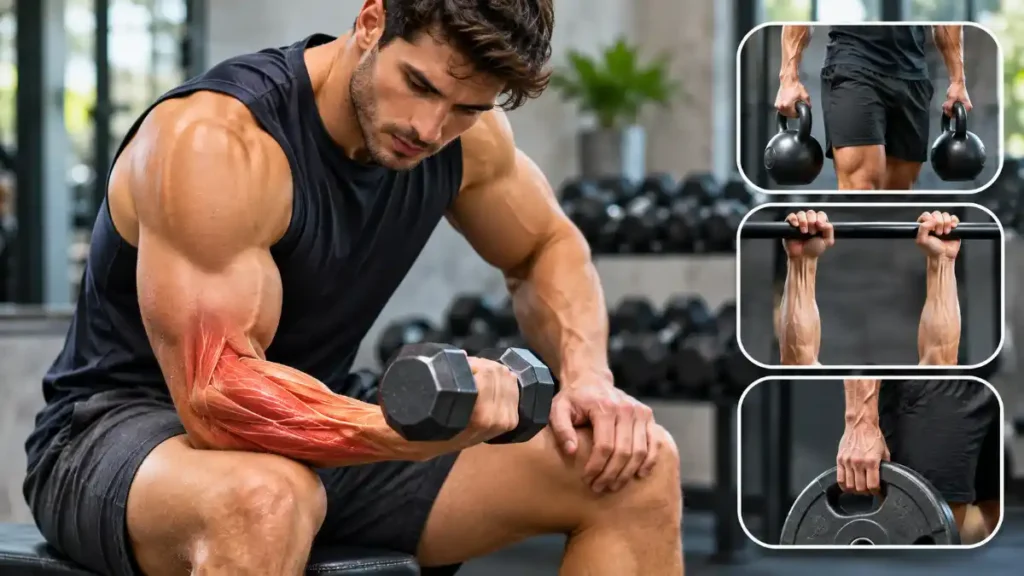
The most effective forearm workouts include wrist curls, reverse wrist curls, hammer curls, grip exercises, and controlled forearm rotation. These five exercises work together to develop the muscles that allow for movement at the wrist joint, flex the elbow, and provide a strong grip. To achieve balanced development of your forearms, pick 3-5 of these exercises and practice them consistently while increasing either the weight used or the number of repetitions performed as your strength increases.
The type of exercise you choose to use to develop stronger, larger forearms does not matter as much as how well the exercise matches what you want to accomplish (i.e., build muscle, increase grip strength, etc.). There are many types of exercises that can help you achieve your goal. These include using dumbbells, resistance bands, and even just your own body weight.
10 Best Forearm Exercises for Strength and Muscle Growth
A comprehensive forearm routine is made up of both dynamic movements (moving the wrist and fingers through a controlled range of motion) and static positions (maintaining a strong grip on an object).
| Exercise | Equipment | Muscles Emphasized | Difficulty | Suggested Reps or Holds | Main Goal |
| Wrist curls | Dumbbells or barbell | Wrist flexors | Beginner | 12–15 reps | Wrist-flexor growth |
| Reverse wrist curls | Dumbbells or barbell | Wrist extensors | Beginner | 12–15 reps | Wrist extension strength |
| Hammer curls | Dumbbells | Brachioradialis, elbow flexors | Beginner | 8–12 reps | Forearm size |
| Reverse curls | Barbell or dumbbells | Brachioradialis, elbow flexors | Intermediate | 8–12 reps | Elbow-flexor development |
| Farmer’s carries | Dumbbells or kettlebells | Finger flexors, wrist stabilizers | Beginner | 20–40 seconds | Supporting grip |
| Dead hangs | Pull-up bar | Finger flexors | Intermediate | 10–30 seconds | Grip endurance |
| Plate pinches | Weight plates | Finger and thumb flexors | Intermediate | 15–30 seconds | Pinch grip |
| Wrist roller | Wrist roller | Wrist flexors and extensors | Intermediate | 1–2 controlled cycles | Forearm endurance |
| Resisted pronation | Band or light dumbbell | Pronators | Beginner | 10–15 reps | Pronation strength |
| Resisted supination | Band or light dumbbell | Supinators, biceps | Beginner | 10–15 reps | Supination strength |
The given repetition and hold ranges are merely recommendations for a baseline of operation; they do not represent absolute requirements. Select a weight/resistance level that is manageable and provides sufficient challenge, yet allows for proper form to prevent injury to your wrist and/or elbow.
Forearm Workout Routines for Beginners, Gym, and Home
You do not have to complete every exercise (all 10) in a single workout. Select a plan based on how much experience you have and what types of gear you own. Perform the exercises in the exact sequence they are presented here, with an emphasis on using control when performing each exercise rather than using heavy weights.
| Routine | Exercise | Sets | Reps or Duration |
| Beginner | Dumbbell wrist curls | 2 | 12–15 |
| Beginner | Reverse wrist curls | 2 | 12–15 |
| Beginner | Farmer’s carries | 2 | 20–30 seconds |
| Gym | Hammer curls | 3 | 8–12 |
| Gym | Reverse wrist curls | 2 | 12–15 |
| Gym | Wrist curls | 2 | 12–15 |
| Gym | Farmer’s carries | 2 | 30–40 seconds |
| Home | Dumbbell wrist curls | 2 | 12–15 |
| Home | Reverse wrist curls | 2 | 12–15 |
| Home | Resisted pronation and supination | 2 each | 10–12 |
| Home | Farmer’s carries | 2 | 20–30 seconds |
Beginner Forearm Workout
When you first start working out your forearms, do so by completing either one or two training sessions a week; make sure that you have at least one day off from working out your forearms before doing another session. Take a 60-90 second break after each set, and work with lighter weights until you are able to perform all of the movements comfortably.
Gym Forearm Workout for Muscle Growth
This program is comprised of specific wrist exercises, elbow flexion movements, and grip training. You should rest for 60-90 seconds between each set. If you are doing a difficult carry, you can take a longer break after it.
Perform this routine at least one time per week. The amount of additional forearm work performed during other routines will determine when to perform this routine. It is more important to be consistent and to maintain a reasonable amount of training volume than it is to squeeze as many sets of exercises as possible into each training session.
Forearm Workout at Home
Dumbbell/Resistance Band Forearm Workout is a great way to work out your forearms if you do not belong to a health club or have restricted space. Work out 1-2 times per week and rest for about 45-90 seconds between each set.
If dumbbells cannot be used, other options include using resistance bands or items in your home that are weighted and have a known weight and will not fall from your hands. Don’t use anything made of glass, anything that has an awkward shape, or anything that could potentially slip out of your hands.
Strength development and muscle building are supported by research on resistance training through the use of resistance bands, body weight exercises, and home-based workouts.
PubMed Central (PMC)
How to Perform Forearm Exercises Correctly
Good form allows you to work the proper muscles, not use momentum to move the weight, and avoid undue pressure on your joints.
Wrist Curls and Reverse Wrist Curls
Sit on a chair or bench so that your forearm rests on your thigh, or some type of sturdy surface. Let your wrist hang over the side of that surface.
To perform a wrist curl, use a dumbbell and hold it so that the bottom of the dumbbell is towards the ceiling. Gently flex your wrist upward to raise the weight. After raising the weight, pause for a moment before slowly lowering the weight back down in a controlled manner.
Reverse wrist curls require you to face your palm down while lifting the top of your hand towards your arm. Typically, this variation uses a smaller amount of weight than a standard wrist curl.
Use the same support for your forearms during both types of movements. Stay in a safe, comfortable zone when performing the exercises, instead of pushing your wrists to the limit. The instructions on how to use these wrist strengthening exercises also teach you to perform the movements under control and against resistance.
American Shoulder and Elbow Surgeons
Hammer Curls and Reverse Curls
Stand tall with your elbows close to your sides, and your shoulders relaxed.
In hammer curls, you will be holding the dumbbells so that your hands are facing toward each other. In reverse curls, you will turn your hands down and continue to hold the dumbbells in that manner as you complete the curl.
Raise the weights by bending your elbows and keeping your upper arms fairly stationary. When you are ready to lower the weights, do so slowly as opposed to allowing gravity to pull the weights downward.
The two exercises each contain the brachioradialis muscle; this is a contributor to the flexion of the elbow joint and forms part of the muscular shape of the lateral side of the forearm.
Farmer’s Carries, Dead Hangs, and Plate Pinches
When performing farmer’s carries,s you will hold a weight in each hand and let your hands hang down. Your wrist should be roughly straight, and you need to remain upright and move at a steady rate. You should avoid leaning too far forward or shrugging your shoulders too much.
To perform a dead hang, hold onto a sturdy pull-up bar, allow yourself to hang freely, and maintain a reasonable amount of control over your shoulders. Ensure that your feet are close to a firm surface so that you will be able to exit the hang safely. If you find the full hang to be too challenging, you can partially support your weight with your feet.
With a plate pinch, you use a weight plate that you can easily control with only your fingers and thumbs. Keep the weight plate vertical and close to your upper body. Also, try to keep the weight plate at a lower height above a flat, empty area so that if you drop the weight plate, you will not damage anything else.
Unlike wrist curls, the primary focus of this exercise is to help you build endurance in keeping your hand on the bar for long periods.
Wrist Rollers and Forearm Rotation
Hold on to both of the handles of the wrist roller and turn your wrists to move the weight up toward you. When you have moved the weight as far up as possible, begin to turn your wrists in the other direction to bring the weight down, being careful not to let the weight fall off of the roller.
With the elbow bent at about 90 degrees and kept close to your body, secure a light resistance band so that it opposes the motion of the rotation. To perform pronation, turn your palm downward, and for supination, turn your palm upward.
As well as using a lightweight, lever-type dumbbell (though the unevenness of the resistance means you’ll need more control), try to maintain as straight a wrist as possible and turn through your forearm, not by rotating your wrist from side to side.
Quick form checklist: Warm up with gentle movements, maintain comfortable wrist alignment, breathe steadily, control every repetition, and stop if an exercise is causing you to experience a sharp or increasing pain.
Which Forearm Muscles Do These Exercises Work?
There are multiple muscle groups located in your forearm area that help to move your wrist, hand, finger, and elbow joints.
- Wrist flexors: Bend your wrist toward your palm.
- Wrist extensors: Extend your wrist and help stabilize it during gripping.
- Finger flexors: Close your fingers and help you grip objects securely.
- Finger and thumb extensors: Straighten and open your fingers and thumb.
- The brachioradialis muscle helps flex the elbow. It is especially useful when doing “hammer” style curls or “reverse” style curls.
- Pronation and supination: Rotate your arm so that your hand is either facing down (palm) or up.
The way the forearm muscles are structured will explain why they can perform a variety of movements.
The use of several different kinds of exercises to train the entire area of your forearm will give you a more complete training program. For example, the use of wrist flexion, wrist extension, gripping, and some types of rotational movements will help to create a balanced approach to the training of the various parts of your forearm.
How Often Should You Train Forearms?
Beginning lifters should begin by doing one to two forearm workouts each week. Advanced lifters can increase their frequency of forearm workouts once they have established a pattern of being able to recover from those workouts and continue to show improvements.
Remember that you will be using your grip strength when performing deadlifts, pull-ups, and heavy rows. You should take into account how much row-based work you do as part of your back workouts (including the different types of row-based work used for rear delt exercises) prior to beginning to train your forearms further.
pitradine.com
If your main goal is to build larger forearm muscles, you should be progressively adding more weight to each set of resistance exercises. If you’re looking to increase your hand strength, then you should select exercises that target the same type of strength as the one you are trying to develop.
- Supporting your grip, farmer’s walks, and dead hangs will assist in keeping control of the weight or bar.
- Crushing grip: The purpose of a hand gripper is to test how much force you can exert when closing your hand.
- Plate pinches build your capacity to grasp items using only your fingers and thumbs.
- Grip endurance: Longer controlled holds help you sustain gripping effort.
You can do forearm training after a back workout or on an arm day. Both of these are fine methods for training your forearms, provided that you give your hands time to recover from the previous workouts and that the tiredness in your forearms does not prevent you from doing your primary exercises.
How to Progress Your Forearm Workouts
You should begin with a resistance level that allows you to successfully perform each of the required repetitions, while maintaining control. When you are consistently able to perform the number of repetitions that has been specified for you, consider increasing the amount of weight used by a small increment.
Before increasing your weight on static exercises like Farmer’s Carries and Dead Hangs, increase the amount of time you hold each exercise.
Do not increase the amount of weight you lift, the number of reps you perform, or the total number of sets you complete at once. Also, you do not need to work until failure each time you go to the gym. It is usually easier to maintain a training schedule that includes working out with challenging efforts, increasing the intensity of your workouts over time, and getting enough rest and recovery between workout sessions.
Common Forearm Workout Mistakes and Safety Tips
The constant stress placed upon your forearm muscles, tendons, and joints during exercise, along with an increase in demand too rapidly and/or bad form, can result in irritation of your wrist and elbow.
Common mistakes include:
- Too much weight: Use a resistance that you can handle without swinging, jerking, or compensating with other muscle groups.
- Forceful wrist positions: Keep movements within a safe, pain-free range of motion.
- Training hard every single day: Be sure to give yourself some time to recover, especially following high-intensity gripping workouts.
- Include extension movements in addition to your wrist curls and grip training, so as not to neglect the wrist extensors.
- Skipping the warm-up: Before you begin working with heavier weights, prepare your wrists and forearms through light movement and lighter sets.
It’s okay to feel a bit of muscle fatigue; however, persistent pain in your tendons, numbness, tingling, or an unexplained loss of strength are all indications you should stop exercising and get assessed by a professional. When considering general wrist pain, if the pain gets worse, you lose sensation, or you can no longer grip objects, those are also signs that you need to be evaluated by a healthcare professional.
Frequently Asked Questions
How long does it take to build bigger forearms?
Forearm growth usually takes consistent training over several weeks or months, although there’s no guaranteed timeline. Your genetics, starting muscle size, training experience, nutrition, and recovery all influence how quickly you notice changes. Rather than expecting visible results by a specific date, track improvements in your repetitions, weights, and grip performance.
Can you build forearms at home without weights?
Yes. Resistance bands and challenging bodyweight exercises can strengthen your forearms without dumbbells or barbells. Supported dead hangs and band-resisted wrist exercises are practical options. As you get stronger, gradually increase the resistance, holding time, or exercise difficulty to keep challenging your muscles.