
Bird Dog Exercise: How to Do It, Muscles Worked, Benefits, and Variations
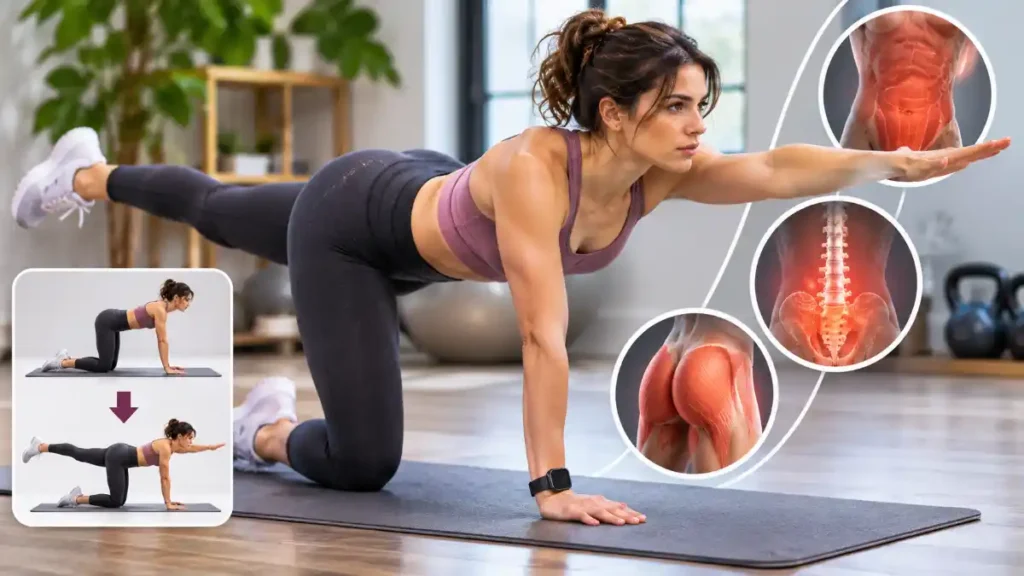
The Bird Dog Exercise is a Bodyweight Core Stabilization Movement Performed On Your Hands And Knees While Extending One Arm And The Opposite Leg. It Strengthens The Muscles That Support Your Spine And Pelvis, Improves Coordination, And Challenges Your Balance As You Keep Your Back Steady.
The bird dog is a great way to train your core to resist moving when you extend your arms and legs. This is different than a crunch because crunches are all about how much you can bend your spine. Also, you do not need any special equipment for this exercise, and it can be modified based on your current fitness level.
| Exercise Overview | Details |
| Equipment | None; exercise mat optional |
| Difficulty | Beginner-friendly with modifications |
| Starting position | Hands and knees (quadruped) |
| Main muscles | Abdominals, spinal extensors, glutes, shoulder stabilizers |
| Movement pattern | Opposite arm and leg extension |
| Beginner repetitions | 5–8 per side, 1–2 sets |
| Main benefits | Core stability, balance, coordination, muscular endurance |
How to Do the Bird Dog Exercise Correctly
To achieve the correct form for a “bird dog” exercise, maintain stability in your upper body (torso) as you move both your arms and legs. When performing this movement, focus more on controlling the movement of each limb than on lifting each limb as high as possible or completing as many repetitions as possible.
1. You should begin by positioning yourself on your hands and knees. Your hands should be placed directly below your shoulders, while your knees should be positioned directly below your hips (about the width of your hips).
2. Set your spinal column. Keep your back in a comfortable, neutral position. Your head and neck should be in alignment with your body’s trunk. Keep looking at the ground.
3. Engage your core. Do not hold your breath as you gently contract your abdominal muscles.
4. Stretch your other two extremities. Gradually extend your right hand towards the front of you, while simultaneously extending your left foot towards the back of you. Both should be positioned horizontally, at about the same level as your body.
5. Continue holding that position. Keep your hips aligned with the ground and your shoulders parallel to each other. Remain in this position for several comfortable seconds.
6. Return slowly to the starting position using control. Move your hand and knee slowly toward the starting position while keeping your upper body still.
7. Switch sides. Extend your left arm and right leg, then continue alternating.
Move slowly enough to have complete control of your movement. As you extend your arms and legs, you will be able to release air from your body. However, as long as you are holding onto a position, continue to breathe normally.
Common Bird Dog Exercise Mistakes
Even if you have minor errors in how you position yourself, it will be more difficult to control the movement, and there may be too much stress on your back.
- Arching your lower back: Don’t let your abdomen sag as you extend your leg.
- Lift your leg to approximately waist level rather than reaching toward the ceiling.
- When you rotate your hips, you want to keep your pelvis parallel with the floor. You don’t want to allow either side of your pelvis to roll out.
- Looking upward: Keep your neck neutral instead of lifting your chin.
- Rushing repetitions: Move deliberately rather than swinging your arms and legs.
- Excessive shifting: Try to balance your weight evenly over your supporting hand and knee.
Do not lock your supporting arm when attempting to keep yourself balanced. If it is difficult for you to maintain balance, then consider shortening the distance of each of your arms or practicing with only one arm extended.
The use of a mirror or a short video to record yourself while practicing will allow you to see where you may be excessively twisting. Resting a lightweight pillow behind your back can provide you with feedback regarding how much your upper body is moving; however, this method does not tell you if your spine is properly aligned.
Bird Dog Exercise Muscles Worked
The bird dog works out multiple parts of the body simultaneously. While some of these parts work to keep your spine in place, other parts work to help you use your hands and feet. This is why the bird dog is so great for learning how to coordinate the movement of your core.
| Muscle or Muscle Group | Role During the Exercise |
| Transverse abdominis | Supports abdominal bracing and trunk stability |
| Rectus abdominis | Helps resist excessive spinal extension |
| Internal and external obliques | Resist unwanted rotation and sideways movement |
| Multifidus | Contributes to segmental spinal stability |
| Erector spinae | Help maintain spinal alignment |
| Gluteus maximus | Extends the hip as your leg reaches backward |
| Hamstrings | Assist hip extension |
| Shoulder stabilizers | Support arm positioning and upper-body control |
Although the bird dog works your abdominal muscles, it does not isolate them. Rather, all parts of your core work together to maintain stability in your upper body, as each leg and arm are able to move separately.
Bird Dog Exercise Benefits
The regular use of bird dog exercises will help develop increased core stability, muscle endurance, and coordination of movement. Additionally, this exercise requires no heavy lifting or repetitive flexion of the spine to challenge the user’s ability to maintain their balance.
Improves core stability
The muscles of the abdomen and spine work together so that you don’t make movements that you don’t want to. This will help you to have better control of keeping your upper body still as you are exercising and doing other daily tasks.
Strengthens lower back muscles
Your spinal extension muscles support the back’s stability during every single repetition of a bird dog exercise. By consistently practicing bird dogs, you may increase the endurance of those supporting muscles.
Develops balance and coordination
Extending an arm and leg on the same side of your body (the same as above) makes it harder for you to balance. Your muscles have to work together so you don’t move around too much or twist yourself.
Strengthens the glutes
In addition, when you push your leg behind you, your gluteus maximus is what enables you to rotate your hips; however, it also assists in preventing excessive pelvic rotation with the help of your core.
Supports functional movement
Learning to stabilize your spine and pelvis during limb movements will help you develop the ability to reach, walk, and lift. In addition, improving your performance in these areas will require development of your overall strength, coordination, and practice with the movement.
The benefits of using Bird Dogs will rely heavily upon a person’s ability to consistently use them, appropriately progress through their usage, and maintain proper form when performing the exercise. Bird Dogs are not capable of ensuring a better posture for a person,n nor can they protect that person from injury to their lower back.
Is the Bird Dog Exercise Good for Lower Back Pain?
Spinal stability training can be achieved using the bird dog exercise as an alternative to repeated flexion and rotation.
For some people who have nonspecific lower back pain, controlled “bird dogs” can be a good option for strengthening the surrounding muscles. However, controlled bird dogs are not always the best treatment for all types of lower back pain, and whether they would benefit you will depend on your symptoms and the underlying cause of your pain.
The McGill Big Three includes the bird dog, as well as the modified curl-up and side bridge. All three exercises are designed to help with trunk stability and muscle endurance.
If you are experiencing ongoing back pain, pain that radiates down your legs or arms, or have been diagnosed with a spinal condition, consult with an individual professional for treatment advice, rather than assuming that the bird dog exercise will cure your issues.
Bird Dog Exercise Variations for Beginners and Advanced Levels
The Bird Dog exercise can be modified to be either easier or more difficult based on how strong you are, how well you can maintain balance, and what level of comfort you have.
| Variation | Difficulty | Best Use |
| Arm-only reach | Easy | Practicing trunk stability with less balance demand |
| Leg-only extension | Easy | Learning hip extension and pelvic control |
| Standard bird dog | Beginner–intermediate | Developing coordinated core stability |
| Longer holds | Intermediate | Increasing muscular endurance |
| Resistance-band bird dog | Advanced | Adding resistance once technique is consistent |
| Supported standing bird dog | Modified | Alternative for people uncomfortable on the floor |
If you are just beginning to do this type of movement, you should extend either your left arm or right leg while supporting all of your other limbs. This will allow you to learn how to control your upper body prior to doing the entire exercise.
When you’re able to keep a steady posture, move on to extending the opposite arm and leg. You can use longer holds or light resistance to challenge yourself with this exercise. However, only do so after you have mastered the proper form.
For a supported standing variation, use a stable surface as a hand rest, then extend one leg back while maintaining control of your upper body. When you have developed sufficient balance, you may advance to moving your opposite hand and foot in unison. This variation modifies the balance and weight-bearing requirements from those of the floor exercise.
If kneeling is uncomfortable, try using an exercise mat with padding. For individuals who experience pain in their wrists when kneeling, a standing modified version of the pose with support or a different posture that does not cause pain can be a more suitable alternative.
How Many Bird Dog Exercises Should You Do?
A good first step for novice users is to perform 1-2 sets of 5-8 repetitions per side, and hold each repetition for 3-5 seconds.
This isn’t an absolute requirement. In fact, some conditioning programs suggest doing a lower number of reps per set and holding each rep for a longer period of time. Therefore, the total number of reps you should do each workout will vary depending on your level of experience, physical capabilities, and what you want to achieve through your conditioning program.
As you get better at controlling your body, you can start increasing either the amount of time you spend holding each pose, the number of times you perform each pose, or the resistance you use during your practice. If your lower back arches, or your hips start to rotate, you should stop practicing that pose and/or switch to a simpler version of it.
Bird Dogs are great for warming up, working on your core strength, or as part of a rehab plan. Your frequency in performing these exercises will be determined by your level of experience, total volume of training, and how quickly you recover.
Bird Dog vs. Plank vs. Dead Bug
All three exercises challenge core stability, but each does so differently.
- Bird Dog: Involves extending your opposite arm and leg while on all fours, making sure that you do so at the same time. This will challenge your balance as well as help you to resist turning (rotation).
- Plank: Primarily challenges you to maintain a stable trunk in a static position.
- Dead Bug – Uses controlled arm and leg movement while lying on your back to focus on trunk stability, without using your hands and knees for weight bearing.
The choice between these exercises will depend on what you want to achieve through your training, how comfortable you feel performing each movement, and where you currently stand physically.
Bird Dog Exercise Safety and When to Stop
The bird dog position should be relatively easy for you to perform, and you should not experience any severe pain or increased discomfort.
Muscular activity that is low in intensity is expected during exercise. However, when you notice increasing back pain, radiating pain down your legs, numbness in your extremities, or an uncharacteristic lack of strength, cease exercising immediately.
If you’re healing after having spinal surgery or are dealing with a severe back problem, receive expert advice prior to incorporating bird dogs into your workout regimen.
If you experience a new bladder or bowel dysfunction, numbness around the groin/saddle area, or a severe/progressive leg weakness that is related to your back pain, seek immediate medical attention.
To stay comfortable during a workout, use controlled movements when exercising, limit how far you lift your legs/arms, and select a variation that enables you to maintain proper body positioning.
Frequently Asked Questions
Can bird dog exercises give you visible abs?
Bird dogs strengthen the muscles that stabilize your abdomen, but they don’t specifically burn belly fat. Visible abdominal definition depends on several factors, including overall body composition and muscle development. Bird dogs can contribute to core strength, but they won’t guarantee visible abs on their own.
How long does it take to see results from bird dog exercises?
There’s no fixed timeline. With consistent practice, you may notice that maintaining balance and controlling your movements becomes easier. Improvements in muscular endurance and strength depend on your starting fitness level, training frequency, and how gradually you increase the difficulty.