Xiphoid Process: What It Is, Where It Is & Why It Can Hurt
Most people never think about the small bump at the bottom of their breastbone – until it starts hurting, feels unusually pronounced, or shows up as a lump they can’t explain. Here’s what the xiphoid process actually is, how variable it can be from person to person, and the handful of situations where that bump deserves a second look.
What Is the Xiphoid Process?
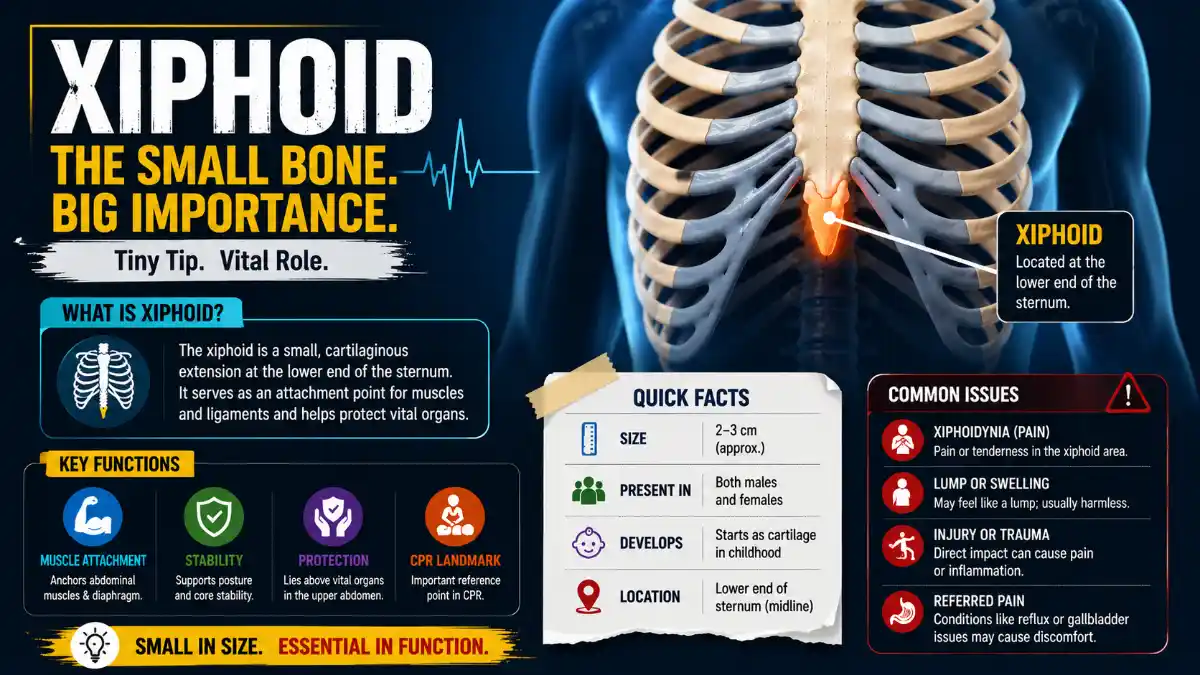
The xiphoid process is the smallest and lowest part of the sternum (breastbone). It sits at the inferior end of the sternum, joined to the sternal body above it by the xiphisternal joint, and serves as an attachment point for several abdominal and chest wall muscles. It starts as cartilage at birth and gradually ossifies into bone, though the pace and final shape vary considerably between individuals.
Where Is It Located?
It sits at the lowest tip of the sternum, in the epigastric region of the chest, at approximately the level of the tenth thoracic vertebra – just above where the ribs curve inward toward the upper abdomen. It connects to the sternal body through the xiphisternal joint, has facets for part of the seventh rib’s cartilage, and attaches inferiorly to the linea alba, the fibrous midline seam running down the abdominal wall.
What Does It Do?
This small structure doesn’t move independently; its role is structural, anchoring several muscles and ligaments:
- The rectus abdominis attaches near its base
- Aponeuroses from the oblique abdominal muscles pass across its surface
- Diaphragm fibers attach along its posterior surface
- The transversus thoracis, a deep chest wall muscle, connects here
- Costoxiphoid ligaments, formed with the seventh rib’s cartilage, help stabilize the lower rib cage
Normal Anatomical Variations
Anatomy textbooks commonly depict the xiphoid process as a single, straight, fully ossified bone. In practice, it’s one of the most variable elements of the sternum. Imaging research examining 500 patients found the following patterns:
| Variation | Reported Frequency |
| Same plane as the rest of the sternum | 33.2% |
| Ventrally deflected (curved forward) | 65.4% |
| Monofid (single) tip | 62.6% |
| Bifid (forked) tip | 32.8% |
| Trifid tip | 4.6% |
| Foramina (small openings) | 43.2% |
Read More: Xiphoid
These figures come from a single imaging study and may not generalize precisely to every population, but they illustrate that shape variation here is well documented rather than exceptional. This is also why an anteriorly deflected or unusually shaped tip is sometimes mistaken for an epigastric mass on imaging, when it’s actually a normal anatomical variant.
Ossification timing shows similar variability: it generally begins around age three in the superior portion, and the xiphisternal joint typically shifts from a symphysis to solid bone by around age 40, though ossification has been reported to continue into the fourth to sixth decades of life in some individuals.
Its Role During CPR
For adult CPR, current resuscitation guidance places the heel of one hand on the center of the chest, over the lower half to lower third of the sternum, with the other hand on top. Compressions should not be delivered directly over the xiphoid tip, because this part of the sternum is comparatively soft; compressing it can fracture the bone and has been associated with injury to the liver, heart, or diaphragm. For complete, current hand-placement and technique instructions, refer to official CPR training resources rather than a general anatomy guide.
Surgeons also use the region just below this tip – the subxiphoid area – as an access point for certain procedures involving the pericardium, and removal of the xiphoid is sometimes performed to improve surgical visualization during other operations, such as total gastrectomy.
Xiphodynia: When This Area Itself Causes Pain
Xiphodynia (also called xiphoid syndrome or xiphoidalgia) is pain and tenderness centered on the xiphoid process or its joint with the sternum. It’s described in the medical literature as uncommon and under-studied, with most of what’s known coming from case reports rather than large clinical trials. Reported associations include mechanical trauma to the chest or heavy lifting, and symptoms can radiate to the upper abdomen, chest, throat, or upper extremity.
Findings such as tenderness reproduced by direct pressure, or pain that shifts with bending or twisting, are described in case literature as features associated with this condition. These findings can support a musculoskeletal explanation, but they are not diagnostic tests and do not, by themselves, rule out cardiac, pulmonary, or gastrointestinal causes of similar pain. Because the presentation overlaps with conditions such as angina, myocardial infarction, pericarditis, pulmonary embolism, peptic ulcer disease, and gallbladder disease, it’s generally treated as a diagnosis made only after these more serious possibilities have been reasonably excluded by a clinician.
Reported management approaches move from rest and activity modification toward clinician-directed local anesthetic or steroid injections in persistent cases, based on case reports describing symptom improvement. Surgical removal for confirmed, treatment-resistant xiphodynia is described as an option for rare, refractory cases, though this reflects case-level evidence rather than results from controlled clinical trials.
Other Causes of Pain in This Region
Several conditions can produce pain that feels like it’s coming from this exact spot without actually involving the bone, and differentiating them is a recognized diagnostic challenge:
- Acid reflux or peptic ulcer disease, both anatomically close to this area
- Gallbladder disease, often associated with fatty meals
- Costochondritis, inflammation of nearby rib cartilage
- Cardiac conditions, including angina or a heart attack
- Pulmonary embolism, a blood clot in the lung
Because these presentations can overlap, a new, severe, or unclear episode of chest or upper-abdominal pain should be evaluated by a clinician rather than assessed through self-diagnosis; pain that seems to reproduce with pressure on the xiphoid does not rule out a more serious cause.
Swollen Xiphoid Process or Lump: Normal vs. Concerning
A firm bump at the base of the sternum may simply be a prominent xiphoid process that has been present long-term and becomes easier to feel after weight loss, since less soft tissue then covers the bone. This is a plausible anatomical explanation rather than a formally studied statistic.
| Finding | Often less concerning | Should be evaluated |
| Long-standing, stable firm bump | ✓ | |
| More visible after weight loss | ✓ | |
| New or enlarging lump | ✓ | |
| Mild soreness after strain | ✓ | |
| Persistent or worsening pain | ✓ | |
| Skin redness, discoloration, or fever | ✓ | |
| Chest pressure with breathlessness | Emergency |
When to See a Doctor
Seek emergency care immediately for sudden or severe chest or upper-abdominal pain accompanied by shortness of breath, chest pressure, unexplained sweating, fainting, or pain spreading to the arm, jaw, neck, or back – recognized warning signs of a possible heart attack or other serious cardiac event. These symptoms should never be assumed to be musculoskeletal based on location alone, since chest-wall tenderness and serious cardiac or pulmonary disease can occasionally overlap.
Book a routine evaluation for pain or a lump that’s new, persistent beyond a couple of weeks, worsening, linked to a significant injury, or accompanied by fever or skin changes. A clinician can assess whether the cause is a normal anatomical variant, a musculoskeletal issue, or something requiring further workup through history, physical exam, and imaging only when it’s genuinely indicated.
Final Thoughts
The xiphoid process is a small, anatomically variable structure that anchors core muscles, has clinical importance during CPR because compressions should be positioned on the sternum rather than over the xiphoid itself, and is occasionally the source of genuine, under-recognized pain through xiphodynia. Much of what’s understood about xiphodynia specifically comes from case reports rather than large studies, so it’s treated in practice as a diagnosis of exclusion rather than a first assumption. Breathing difficulty, a changing mass, or pain that doesn’t resolve are the situations that call for medical evaluation rather than self-assessment.
Frequently Asked Questions
Is the xiphoid process the same as the “solar plexus”?
No. The xiphoid process is a bony landmark at the bottom of the sternum, while the solar plexus refers to a network of nerves (the celiac plexus) located deeper in the abdomen behind the stomach. The two terms get confused because people sometimes use “solar plexus” loosely to describe the general area below the breastbone, but they’re anatomically distinct structures.
Why does my xiphoid process stick out?
A prominent or protruding tip can reflect normal anatomical variation; imaging research has found that a majority of xiphoid processes are curved or deflected rather than perfectly aligned with the sternum. It may also become easier to feel after weight loss, since there’s less soft tissue covering the bone. It’s worth checking only if it’s linked to new pain, follows a recent injury, or is mistaken for an abnormal mass.
Why does my xiphoid process hurt?
Possible causes include musculoskeletal strain, direct trauma, xiphodynia, and pain arising from nearby chest-wall structures such as inflamed rib cartilage. Reflux, gallbladder disease, and cardiac or pulmonary conditions can also cause pain felt in the same region without involving the xiphoid itself. Persistent, severe, or unclear pain should be evaluated by a clinician rather than self-diagnosed.
Can the xiphoid process feel like a lump?
Yes. A firm bump at the base of the sternum may simply be a prominent xiphoid process that’s become easier to feel, particularly after weight loss, rather than a new growth. A lump that’s new, rapidly enlarging, hard and fixed in place, or accompanied by skin changes falls outside this typical pattern and should be examined.
When should this kind of pain be checked by a doctor?
Seek emergency care immediately if pain is sudden or severe and comes with shortness of breath, chest pressure, sweating, fainting, or pain spreading to the arm, jaw, or back, since these are recognized warning signs of a possible heart attack. Schedule a routine evaluation for pain or a lump that’s new, persistent beyond a couple of weeks, worsening, or accompanied by fever or skin changes.