
Carabiner Safety Explained: What the kN Numbers, Locks, and Shapes Actually Mean.
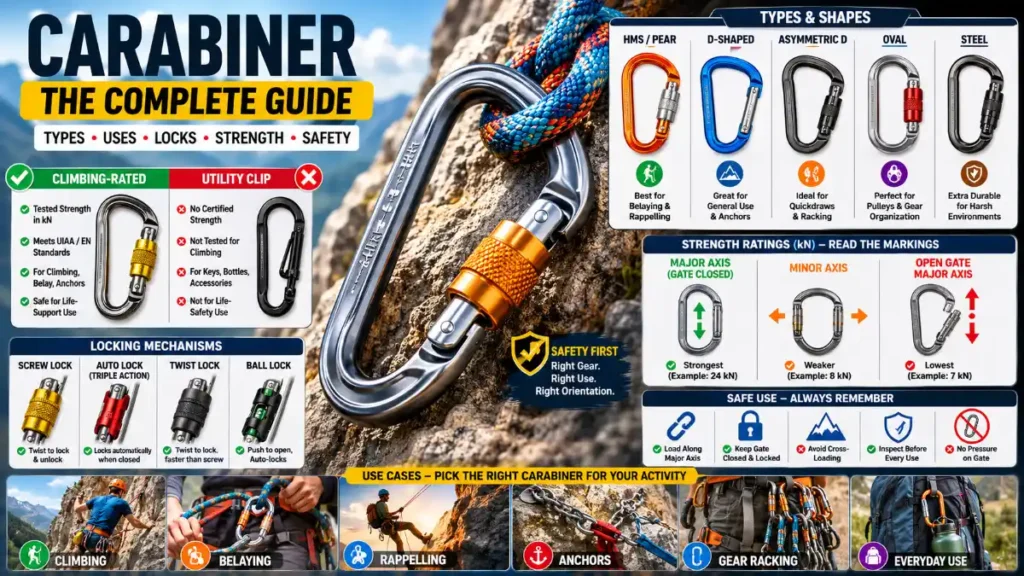
A carabiner is a climbing connector designed to join components of a rope, protection, anchor, harness, or other compatible equipment. Its safety depends on more than the strength number printed on the spine: loading direction, gate position, orientation, condition, compatibility, and intended use all matter. A climbing-rated connector should never be confused with a general-purpose clip or carabiner keychain.
For climbing, the basic rule is simple: load the connector along its major axis with the gate fully closed, while keeping the connector correctly positioned and free from hazardous contact or cross-loading. Manufacturers commonly mark climbing connectors with major-axis, minor-axis, and open-gate strength values, expressed in kilonewtons (kN). Current manufacturer specifications illustrate why those numbers can differ substantially between loading conditions.
What Is a Carabiner?
A carabiner is a metal connector with a spring-loaded gate that allows equipment to be attached and detached. In climbing, it is part of a larger system rather than an isolated piece of equipment.
Depending on its design, a connector can be used for quickdraws, protection, belaying, rappelling, anchors, equipment organization,n and other climbing applications. Different shapes and gate mechanisms exist because different tasks create different handling, alignment, and loading requirements.
The important distinction is between climbing-rated connectors and utility clips.
A climbing connector is manufactured and tested for defined performance requirements. Standards such as EN 12275 and UIAA 121 cover connectors used in mountaineering and climbing. By contrast, an everyday clip sold for keys, bottles, or backpack accessories may have no climbing certification at all.
That distinction matters even when two products look almost identical.
Carabiner Strength Ratings: What the kN Numbers Mean
The markings on a climbing connector normally communicate its minimum breaking strength under specified test conditions. Three values are particularly important:
| Rating | Loading condition | Why it matters |
| Major axis, gate closed | Load runs through the strongest lengthwise orientation | Normally the highest rated configuration |
| Minor axis | Load is applied across the shorter axis | Considerably weaker than major-axis loading |
| Major axis, gate open | Connector is loaded lengthwise while the gate is open | Lower strength than closed-gate loading |
Read More: Carabiner
For example, current climbing products from major manufacturers show combinations such as 20–25 kN on the major axis and around 7–9 kN on the minor axis or open gate, depending on the specific design. Those numbers are product-specific, not universal specifications for every connector.
What Does kN Mean?
kN means kilonewton, a unit of force.
It is more appropriate than describing climbing equipment with a simple “weight capacity” because climbing systems can experience dynamic forces. A falling climber does not impose the same loading as a stationary person simply hanging from a connector.
Rope elasticity, fall distance, belay technique, rope path, anchor arrangement, and other components affect the forces generated in a climbing system. Therefore, a rating such as 24 kN should not be converted into a claim that a connector can safely support a particular number of people or a particular body weight.
The useful question is not:
“How much weight can this connector hold?”
It is:
“Is this certified connector being used in the orientation and system for which it is designed?”
Why Major-Axis Loading Matters
A connector is strongest when the primary load runs through its intended major axis, and the gate is properly closed.
The spine is designed to carry the main load efficiently. Problems arise when the connector rotates, rests on an edge, becomes trapped against another component, or is pulled through the gate or minor axis.
Petzl specifically warns that loading outside the intended major-axis, closed-gate configuration can significantly reduce strength. Its technical information gives examples where open-gate or minor-axis loading provides only a fraction of the major-axis strength.
This is why simply seeing a high kN number on the spine is not enough.
Cross-Loading: Why Orientation Matters
Cross-loading occurs when the main force is applied across the minor axis rather than along the major axis.
This can happen when a connector rotates under tension or when multiple components crowd the attachment point. The result may place the load closer to the gate or side of the frame, where the connector has a substantially lower rated strength.
A locking mechanism does not automatically prevent cross-loading.
The gate can remain securely locked while the entire connector sits in the wrong orientation. That is why correct positioning remains essential even when using a locking carabiner.
Before loading a system, check:
- The connector is seated correctly.
- The load is directed through the major axis.
- The gate is not bearing the load.
- The connector is not resting against an edge.
- Other hardware cannot force the connector into an awkward position.
- The rope, sling, or device does not cause the connector to rotate into a weaker orientation.
Some specialized designs incorporate features intended to help maintain correct orientation. However, those features supplement correct setup rather than replacing it.
Read More: Carabiner
Open-Gate Loading Is a Serious Concern
A closed gate forms part of the connector’s intended structural configuration. When the gate is open, the strength is lower.
A gate can remain open because of direct user error, but it can also be forced open or prevented from closing by contact with a bolt hanger, rock, sling, rope, another connector,r or equipment.
A nose-hooked configuration can be particularly dangerous because the connector may be held in an abnormal position while simultaneously experiencing open-gate and off-axis loading. Black Diamond’s testing shows that this type of loading can produce dramatically lower failure loads than the connector’s rated closed-gate major-axis strength.
Before weighting a climbing system, confirm that:
- The gate is fully closed.
- The gate is seated correctly against the nose.
- Nothing is pressing against the gate.
- The connector is not hooked over an object in a way that changes its loading.
- The connector remains correctly oriented after the system is tensioned.
Locking vs. Non-Locking Carabiners
The choice between locking and non-locking connectors depends on the application.
A non-locking connector is designed for quick attachment and detachment. It is common in quickdraws and gear-racking applications.
A locking carabiner incorporates a mechanism that helps prevent unintended gate opening. It is commonly used for applications such as belaying and certain anchor or rappel connections where inadvertent opening would have serious consequences.
A locking mechanism is an additional security feature, not a substitute for correct loading.
Screwgate Locking Carabiners
A screwgate uses a threaded sleeve that the user manually turns over the gate.
Its main advantage is straightforward operation and easy visual confirmation. Its main limitation is equally straightforward: the user must actually close and lock it.
A screwgate that has been left unlocked is not providing the intended locking function.
Before using one in a critical connection, check that the gate closes completely and that the sleeve is properly engaged according to the manufacturer’s instructions.
Auto-Locking Carabiners
Auto-locking designs use a mechanism that automatically returns the locking sleeve or system toward the locked position after the gate closes.
Different designs use different opening sequences. Some require twisting, pulling, pushing, or multiple actions.
Auto-locking connectors can be useful when repeated opening and automatic relocking are desirable. However, the user still needs to understand the mechanism and verify that it has actually locked.
If you are unfamiliar with a particular auto-locking design, learn its operation before relying on it during a high-consequence climbing transition.
Belay Carabiners and HMS Shapes
A pear-shaped or HMS connector provides a relatively broad upper basket that can accommodate a belay device or Munter hitch more effectively than many compact shapes.
The shape is useful because the equipment needs room to move while the connector remains correctly positioned.
Some specialized belay connectors also include geometry intended to help keep the belay loop and device positioned correctly. These features can reduce unwanted movement, but compatibility with the specific harness and belay device remains essential.
Read More: Carabiner
Carabiner Types and What They Are Designed For
There is no universally “best” shape. The correct type depends on the job.
Pear-Shaped or HMS
Pear-shaped connectors are particularly associated with belaying and rappelling.
Their wider basket provides useful space for a belay device or compatible hitch system. Locking versions are commonly selected for these applications.
They can be less convenient for compact gear-racking tasks because the larger basket adds bulk.
D-Shaped
A D-shaped connector directs much of the primary load toward the spine and provides a useful balance between strength, gate opening, and handling.
It is widely used for general climbing connections, gear organization,n and various protection applications, depending on the exact model.
Asymmetric D
An asymmetric D moves the upper basket and gate geometry to provide a useful combination of a large gate opening and efficient loading.
These are common on quickdraws and are also useful for general climbing gear.
The shape does not eliminate the need for proper orientation. A lightweight connector can still be dangerously loaded if it is cross-loaded or trapped against an object.
Oval
Oval connectors have a more symmetrical shape.
That geometry can help keep equipment centralized and reduce some types of shifting when several pieces of gear are carried together. Ovals have long been used in applications including aid climbing and pulley-related systems.
Their value is the alignment and handling provided by the shape, not a claim that they are inherently safer than every other connector.
Gate Types: Straight, Bent, and Wire
Gate design affects how easily a connector clips and how it behaves in a particular application.
| Gate style | Common application | Main advantage |
| Straight gate | Protection-side quickdraws and general climbing | Predictable clipping and handling |
| Bent gate | Rope-side quickdraws | Easier rope clipping |
| Wiregate | Lightweight and alpine applications | Low weight and useful performance in cold conditions |
| Solid gate | General climbing applications | Robust handling and commonly available keylock designs |
Read More: Carabiner
A bent-gate connector is frequently used on the rope end of a quickdraw because its geometry makes rope clipping easier. Manufacturers design these connectors for that specific role.
Wiregates are popular when low weight matters, particularly on alpine or long routes. A wire gate is not automatically weaker simply because it looks different; the relevant strength is the specification of the particular product.
When a Non-Locking Connector Is Appropriate
Non-locking connectors are not simply cheaper versions of locking models.
They are an important part of climbing systems where rapid clipping is required. Quickdraws are the obvious example: the rope-side connector is designed for efficient clipping, while the protection-side connector attaches to bolts, protection,n or other hardware according to the quickdraw’s intended configuration.
Forcing a locking connector into every application can add unnecessary weight and complexity. Conversely, replacing a required locking connector with a non-locker can remove an important part of the intended system.
Always follow the equipment manufacturer’s instructions and the configuration for which the component was designed.
Climbing Carabiner vs. Utility Clip
This is one of the most important distinctions for beginners.
A climbing carabiner is a tested climbing connector with markings and specifications appropriate to its intended application.
A utility clip may be designed for:
- Keys
- Water bottles
- Backpacks
- Gloves
- Small tools
- Flashlights
- Camping accessories
A carabiner keychain can be extremely useful for organization, but it should not be treated as climbing protection unless the manufacturer explicitly states that it is certified and appropriate for the relevant life-safety application.
Words such as “heavy duty,” “tactical,” “military style,” or “outdoor” do not by themselves establish climbing certification.
Appearance is not a certification.
How to Choose the Right Carabiner
Choosing a connector is easier when you start with the application rather than the shape.
For Quickdraws
Choose connectors designed for quickdraw use. A straight gate is commonly used on the protection side, while a bent gate is often used on the rope side.
For Belaying
Use a locking connector that is specifically compatible with the belay device and harness system. An HMS or purpose-built belay design can make positioning easier.
For Rappelling
Use the connector specified by the rappel or belay system. Check compatibility, locking requirements, and manufacturer instructions rather than selecting solely by kN rating.
For Anchors
Use connectors appropriate to the anchor system and configuration. Pay particular attention to orientation, gate interference, edge loading,g and the possibility of components shifting.
For Gear Organization
A non-locking connector can be appropriate when the task is simply carrying or organizing equipment. Do not confuse convenience with life-safety certification.
Understanding Carabiner Weight Ratings
The phrase carabiner weight rating can be misleading.
Climbing connectors are generally specified by strength in kN under defined loading conditions rather than by a simple maximum user weight. A major-axis strength value is a force rating from testing; it is not a permission to suspend a particular amount of body weight from the connector in any configuration.
For example, two connectors can both be marketed as climbing equipment while having different major-axis, minor-axis, and open-gate ratings. Current manufacturer specifications demonstrate that the exact values depend on the model.
Do not use the highest number on a product as the only basis for choosing it.
Inspecting a Carabiner Before Use
A pre-use inspection should be quick but deliberate.
Check the entire frame for cracks, deformation, deep wear, corrosion, or other damage. Pay particular attention to the gate, hinge, nose, and areas where rope or hardware repeatedly contacts the connector.
Then operate the gate.
It should move correctly and return to the closed position as intended. On a locking model, confirm that the locking mechanism functions correctly.
Also check the markings. If the identity, strength markings,s or history of the connector are uncertain, do not assume that it is suitable for a critical application.
Manufacturers provide specific inspection and retirement guidance, and those instructions take priority over generic rules. Petzl, for example, advises retiring equipment when it fails inspection, has been subjected to certain major events, has an unknown history,y or otherwise raises doubt about its integrity.
Read More: Carabiner
When Should You Retire a Climbing Carabiner?
Retire a connector when its condition no longer gives you confidence that it can perform as intended.
Potential retirement reasons include:
- Cracks or structural damage
- Significant deformation
- Deep grooves or severe wear
- Sharp or damaged rope-contact surfaces
- Severe corrosion
- A gate that does not close correctly
- A locking mechanism that does not function reliably
- Damage from a significant event
- Unknown history
- Conditions identified by the manufacturer as requiring retirement
Do not bend a deformed connector back into shape or attempt structural repairs.
Do not file away damaged areas, drill the frame, weld the connector, or otherwise modify it unless the manufacturer specifically authorizes the procedure. Unauthorized modification can compromise the equipment.
If there is serious doubt about a life-safety connector, retirement is safer than trying to make it usable again.
A Simple Carabiner Safety Check
Before using a climbing connector in a critical system, work through this sequence:
- Confirm the category. Make sure it is appropriate climbing equipment for the intended application.
- Check the markings. Read the strength ratings and product information.
- Check the frame. Look for cracks, deformation, corrosion,n and excessive wear.
- Check the gate. Make sure it opens and closes correctly.
- Check the lock. If it is a locking model, verify that the locking mechanism is properly engaged.
- Check orientation. Keep the primary load along the major axis.
- Check interference. Make sure nothing can press against the gate or force an abnormal loading position.
- Check compatibility. Confirm that the connector is suitable for the rope, device, sling, harness, or anchor component involved.
- Recheck after loading. Components can move when tension is applied.
- Stop if uncertain. If the setup or equipment condition is questionable, do not rely on it until the issue has been resolved according to appropriate equipment guidance.
Frequently Asked Questions
Is a 20 kN carabiner stronger than a 25 kN carabiner?
A 25 kN rating is higher than a 20 kN rating when the same loading condition and comparable specifications are being considered. But strength numbers should not be compared in isolation. Major-axis, minor-axis,s and open-gate ratings describe different test configurations.
What does 24 kN mean on a carabiner?
It indicates a specified force rating under the manufacturer’s test conditions, usually referring to the major-axis closed-gate strength when displayed as the primary rating. It should not be interpreted as a simple body-weight capacity.
Is a locking carabiner always safer?
Not automatically. A locking mechanism can reduce the likelihood of unintended gate opening, but it does not prevent cross-loading, incorrect orientation, edge loading, or use of an incompatible system.
What is the difference between a climbing carabiner and a carabiner keychain?
A climbing connector is manufactured and tested for defined climbing applications and carries relevant specifications. A carabiner keychain is normally an accessory for carrying or organizing items and should not be used for climbing or other life-safety applications unless specifically certified for that purpose.
Are wiregate carabiners safe for climbing?
Yes, a properly certified wiregate connector can be suitable for climbing when used according to its intended application and specifications. The relevant question is the product’s tested performance, not simply whether the gate is made from wire.
Can a locking carabiner be cross-loaded?
Yes. Locking the gate does not guarantee correct orientation. The connector can still rotate so that the primary load is applied across its minor axis or in another unintended direction.
Why do carabiners have different kN ratings?
Different ratings describe different loading conditions. Major-axis closed-gate loading is normally stronger than minor-axis or open-gate loading. The exact values vary by product design.
Are oval carabiners only used for aid climbing?
No. Their symmetrical geometry can be useful wherever centralized gear positioning and predictable alignment are helpful. The appropriate application depends on the specific connector and system.
How do I know when a carabiner is worn out?
Look for structural damage, deformation, severe corrosion, deep wear, sharp edges, malfunctioning gates or locks, and any condition identified by the manufacturer as requiring retirement. When the history or integrity is uncertain, follow the manufacturer’s retirement guidance rather than guessing.
Can I use any carabiner for rappelling?
No. Use a climbing-rated connector appropriate for the rappel system and compatible with the device and other equipment. Follow the manufacturer’s instructions and use appropriate training and technique. A generic utility clip should never be substituted simply because it looks strong.