
Dupe Meaning Explained: How Affordable Alternatives Changed Beauty and Fashion Shopping
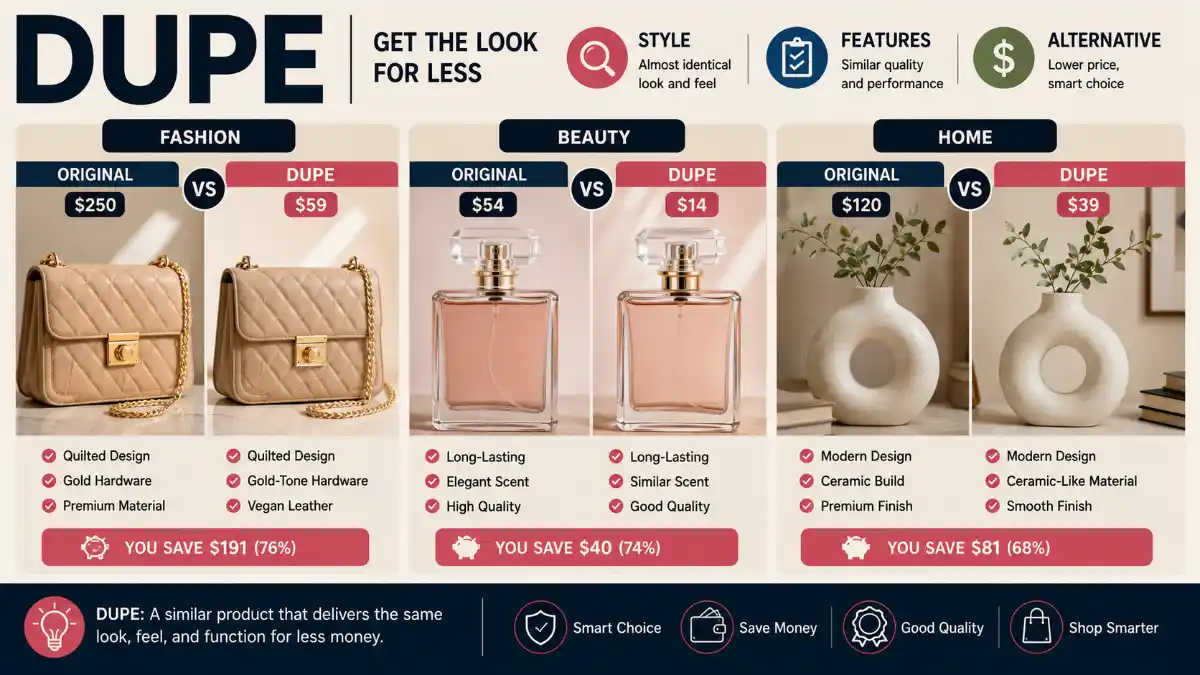
The word dupe has become a familiar part of online shopping, especially in beauty and fashion. Shoppers use it when they find a less expensive product that resembles a popular or premium item in appearance, function, ingredients, materials, or overall effect. Social media has made these comparisons easier to discover, discuss, and share, turning affordable alternatives into a major part of modern product discovery.
But a lower price and a similar appearance do not automatically mean two products are equal. A useful comparison looks at what actually matters: performance, materials, ingredients, construction, durability, seller reliability, and total cost. It is also important to understand the difference between an independently branded alternative and a counterfeit product pretending to be authentic.
What Does Dupe Mean?
A dupe is a product that consumers consider a lower-cost or more accessible alternative to another, usually more expensive or better-known product.
The comparison can be based on several things:
- Similar appearance or design
- Similar function
- Similar ingredients or formulation
- Similar color, finish, or texture
- Similar fabric, silhouette, or construction
- Similar overall user experience
- A substantially lower price
The term is informal. It does not guarantee that two products are identical, and it does not by itself describe the legal status of a product.
For example, a shopper might call one lipstick a dupe for another because the shades and finishes are close. A handbag might receive the same label because its silhouette resembles a designer style. In both situations, the comparison describes perceived similarity rather than proof that the products were manufactured by the same company.
That distinction matters because similar does not mean identical.
Dupe vs. Replica vs. Counterfeit
These terms are frequently used interchangeably online, but shoppers should distinguish them.
| Term | General meaning |
| Dupe | An independently branded alternative that consumers compare with another product |
| Replica | A product intended to reproduce another product; its meaning and legal treatment can vary |
| Counterfeit | A product that uses another brand’s identity or protected identifiers without authorization and may falsely suggest authenticity or affiliation |
Read More: Dupe
A genuine alternative normally makes it clear which company actually made the product. A counterfeit, by contrast, can be designed to make shoppers believe they are purchasing the authentic branded item.
That difference is important when shopping online. The U.S. Patent and Trademark Office explains that trademarks identify the source of goods and services, while trademark infringement can involve unauthorized use that is likely to cause confusion, deception, or mistake about the source.
This does not mean that every visually similar product is automatically legal or that every alternative is automatically safe from intellectual-property claims. Trademark, copyright, design rights, patents, trade dress, advertising rules, and other laws can apply depending on the product and jurisdiction.
For consumers, the safest practical distinction is simple: an honestly branded alternative is not the same thing as an item falsely presented as an authentic branded product.
Why Dupe Products Became So Popular
Affordable alternatives have existed for decades. What changed is how quickly shoppers can discover and compare them.
Social platforms allow creators to place products side by side, demonstrate how they perform, explain differences, and direct viewers toward retailers. That makes comparison itself part of the shopping experience.
TikTok’s current shopping research shows how strongly discovery and comparison are connected to modern purchasing behavior. Its 2026 trend report says shoppers are increasingly using TikTok to compare and validate products after recommendations from friends, stores, or AI, while its beauty reporting highlights continued growth in beauty discovery and shopping activity.
There is also a psychological element. Finding an affordable alternative can feel like discovering a bargain rather than simply purchasing a cheaper product. Sharing that discovery gives shoppers another reason to participate.
The appeal therefore comes from more than price:
- Lower financial commitment
- Easier experimentation with trends
- Greater product choice
- Social sharing and comparison
- Access to popular aesthetics at different budgets
- An opportunity to test a category before spending more
That combination explains why the language around alternatives has become so common in online shopping.
Beauty Dupes: What Should You Compare?
Beauty is one of the biggest areas for comparison because products can be evaluated through ingredients, shade, texture, finish, wear, and application.
However, a product that looks similar in a short video is not necessarily a true performance match.
Compare Ingredients and Formulation
When comparing skincare or cosmetics, read the ingredient list rather than relying entirely on phrases such as “luxury alternative” or “same as.”
Two formulas may share several ingredients but behave differently because of ingredient concentrations, supporting ingredients, texture, fragrance, preservatives, or manufacturing processes.
Likewise, two products with different ingredient lists can sometimes produce a broadly similar cosmetic effect.
The useful question is not simply, “Does this contain the same ingredient?” It is, “Does the overall formulation deliver the result I need?”
Compare Shade, Finish, and Wear
For makeup, compare:
- Shade
- Pigmentation
- Finish
- Blendability
- Texture
- Transfer resistance
- Wear time
- Oxidation
- Application method
A foundation alternative, for instance, may look similar initially but wear differently several hours later. A lipstick may have a nearly identical shade but a different finish or longevity.
Check Product Labels
Beauty products should be evaluated according to their actual labels and instructions. If you have known sensitivities or allergies, ingredient information matters more than a creator’s claim that two products are “the same.”
A cheaper product should never be assumed to be safer simply because it has become popular online.
Fashion Dupes: Similar Look, Different Construction
Fashion comparisons often focus heavily on appearance, but photographs cannot reveal every quality difference.
When comparing clothing, bags, shoes, or accessories, examine:
- Fabric or material composition
- Measurements
- Stitching
- Hardware
- Lining
- Closures
- Weight
- Fit
- Color
- Care requirements
- Return policy
A cheaper garment may reproduce the general silhouette of a premium item while using a different fabric or construction method. That may be perfectly acceptable if appearance is the buyer’s main priority.
But if durability, comfort, construction quality, or long-term use matters, visual similarity is only one part of the decision.
This is particularly important with designer dupes. A product can resemble a designer aesthetic without being the same product, and shoppers should not assume that a similar appearance means the same materials, craftsmanship, warranty, or expected lifespan.
Read More: Dupe
Why the Original Product Can Still Be Worth the Money
The popularity of affordable alternatives does not eliminate the reasons people buy premium products.
The original may provide:
- A specific formulation
- Specialized materials
- Particular construction techniques
- A distinctive fit
- Brand-backed customer service
- Warranty coverage
- Repair or replacement programs
- A specific design experience
- Established quality control
The better question is therefore not simply whether the alternative is cheaper.
It is whether the cheaper option provides enough of the qualities you value.
Someone buying a seasonal fashion trend may reasonably prioritize appearance and price. Someone buying a handbag they expect to use for years may care much more about construction, hardware, repairability, and durability.
The same product can therefore be excellent value for one shopper and poor value for another.
How to Find the Best Dupes
The best dupes are not necessarily the products that look most similar in a viral video. They are products that provide the characteristics a particular shopper actually wants at a worthwhile total cost.
Use this process before buying.
1. Decide What You Are Trying to Match
First identify the attribute that attracted you to the original.
Is it:
- Appearance?
- Function?
- Shade?
- Finish?
- Material?
- Ingredient profile?
- Fit?
- Specific feature?
- Overall aesthetic?
If you cannot identify what you are trying to match, comparison becomes much less useful.
2. Compare Specifications
Move beyond photographs.
For fashion, check measurements and material composition. For beauty, inspect the ingredient list and product claims. For other consumer products, compare dimensions, materials, compatibility, included accessories, warranty information, and operating features.
3. Look Beyond the Star Rating
Ratings can be useful, but they should not be the only evidence.
The Federal Trade Commission advises consumers not to rely solely on star ratings because reviews can be fake or misleading. It also recommends researching the product and company and looking for complaints or other customer experiences.
Look for repeated patterns across reviews rather than one extremely positive or negative comment.
4. Calculate the Total Cost
A product’s displayed price is not always its final cost.
Consider:
- Shipping
- Taxes
- Handling charges
- Required accessories
- Return costs
- Replacement frequency
The FTC specifically recommends considering the full cost of an online purchase, including shipping, handling, delivery, taxes, and other fees.
5. Check the Seller
A good product from an unreliable seller can still become a bad purchase.
Before ordering, check the seller’s reputation, contact information, return policy, refund process, and marketplace protections.
Be especially careful when a supposedly authentic branded product is offered at an unusually low price. The FTC warns that bargain-priced expensive brand-name goods can be counterfeit or otherwise problematic.
6. Treat Viral Comparisons as Research Starting Points
A creator may have a genuine positive experience, but one demonstration does not establish universal performance.
Use social media to discover products, then verify the important details independently.
This is especially important when an influencer or affiliate has a commercial relationship with the seller or brand.
Are Affordable Dupes Actually Better Value?
Sometimes they are. Sometimes they are not.
The cheapest option is not automatically the best value.
Consider this simple comparison:
| Factor | What to check |
| Price | Full purchase cost |
| Performance | Does it accomplish the intended job? |
| Quality | Materials, formulation, and construction |
| Durability | How long is it likely to remain useful? |
| Risk | Seller reputation, returns, warranty, and authenticity |
| Convenience | Availability, shipping, and customer service |
Read More: Dupe
Imagine two products that perform similarly. If one costs significantly less and has a reliable return policy, the alternative may offer excellent value.
But imagine the cheaper product needs to be replaced several times, has inconsistent sizing, or cannot be returned. Its lower initial price may not represent a genuine saving.
Value is therefore about the relationship between price, performance, quality, and risk.
The Legal Reality Behind Fashion and Beauty Alternatives
The legal side of comparison shopping is more complicated than social-media captions often suggest.
In the United States, trademark infringement generally involves unauthorized use of a trademark in a way that is likely to cause confusion, deception, or mistake about the source of goods or services. The USPTO notes that similarity can involve appearance, sound, meaning, or overall commercial impression, while the relationship between the goods or services also matters.
That means the simplistic rule “if it looks similar, it is illegal” is not reliable.
The opposite statement—“if it is sold as a dupe, it is legal”—is also unreliable.
Other forms of intellectual-property protection may apply depending on the circumstances. Packaging, artwork, product designs, inventions, distinctive trade dress, and advertising claims can raise different questions.
The law also differs between countries. A product’s position under U.S. law does not automatically determine its legal status elsewhere.
For ordinary shoppers, the practical lesson is more useful than trying to interpret a complicated legal test: avoid products that falsely claim to be authentic, misuse another company’s branding, or deliberately create confusion about who made the product.
How to Spot a Potential Counterfeit
A counterfeit is different from an independently branded alternative.
When shopping for branded goods, watch for warning signs such as:
- An unusually low price for an expensive branded item
- Misspelled brand names
- Poor-quality packaging
- Incorrect logos
- Printing errors
- Suspicious seller information
- Claims of authenticity without credible verification
- Product photos that appear copied from official listings
- A return policy that is unclear or unusually restrictive
The USPTO recommends checking price, packaging, and where the product is being sold when evaluating potentially counterfeit goods. It also recommends buying directly from brand owners or authorized retailers when possible.
A low price alone does not prove that something is fake. It is the combination of warning signs that should make a shopper stop and investigate.
The Ethical Question Around Dupe Culture
The ethical debate is separate from the legal question.
Some shoppers see alternatives as a way to make fashion and beauty more accessible. Others are uncomfortable with products that appear to imitate independent designers or rely on extremely rapid production cycles.
There is no single ethical answer for every product.
A thoughtful buyer can consider:
- How closely the item imitates another product
- Whether the seller is transparent
- Product quality
- Expected lifespan
- Manufacturing information
- Materials
- Returnability
- Whether the purchase is likely to be used regularly
Buying a cheaper alternative does not automatically make someone unethical, just as paying a premium price does not automatically make a purchase ethical.
The important distinction is that legal, ethical, and good-value are three different questions.
Where Dupe Culture Is Heading
Comparison shopping is unlikely to disappear while social platforms continue combining entertainment, search, recommendations, reviews, and commerce.
What is changing is the quality of information shoppers need.
Consumers now have more product comparisons available than ever, but they also encounter affiliate content, sponsored recommendations, promotional claims, manipulated reviews, and short-form demonstrations that cannot show long-term performance.
That creates an interesting shift. The most useful shopping content is no longer simply “This looks exactly like the expensive one.”
A stronger comparison answers:
- What is actually similar?
- What is different?
- Who should buy the cheaper option?
- Who should buy the original?
- What quality trade-offs exist?
- Is the price difference meaningful?
- Is the seller trustworthy?
- Is the product genuinely independent, or is it being presented deceptively?
That is where comparison-led shopping becomes genuinely useful rather than simply another viral trend.
Frequently Asked Questions
What Does Dupe Mean in Shopping?
In shopping, a dupe generally means a lower-priced or more accessible product that consumers consider similar to another, usually more expensive or well-known product. The similarity may involve appearance, function, ingredients, materials, or overall effect.
Are Dupe Products the Same as Counterfeits?
No. An independently branded alternative is not the same thing as a counterfeit. A counterfeit may use another brand’s identity or protected identifiers in a way that falsely suggests authenticity or affiliation.
Are Beauty Dupes the Same as the Original?
Not necessarily. Two beauty products can have similar shades, finishes, ingredients, or effects while still using different formulations. Ingredient lists, texture, wear, application, and performance should be compared separately.
What Makes the Best Dupes Worth Buying?
The best option is the one that matches the qualities you actually care about while providing a worthwhile price advantage. Price, performance, quality, durability, seller reliability, and return terms should all be considered.
Are Fashion Dupes Lower Quality?
Not automatically. Some affordable fashion alternatives can provide good value, while others reduce costs through materials, construction, or quality control. Check fabric composition, measurements, stitching, hardware, and reviews instead of judging solely by appearance.
Are Designer Dupes Legal?
There is no universal yes-or-no answer. Legal treatment can depend on trademarks, designs, copyright, patents, trade dress, advertising, the product itself, and the jurisdiction. In the United States, trademark analysis can involve whether consumers are likely to be confused about the source or affiliation of goods.
How Can I Tell if a Product Is a Counterfeit?
Look at the seller, price, packaging, branding, product details, and authenticity claims. An unusually cheap branded item, incorrect logo, poor packaging, or suspicious seller can be a warning sign. The USPTO recommends paying attention to price, packaging, and place of purchase.
Should I Trust Viral Dupe Videos?
Use them for discovery, not as your only evidence. Compare independent reviews, product specifications, ingredients or materials, seller information, and return policies before buying.
Is a Cheaper Dupe Always Better Value?
No. A lower price is only one part of value. Durability, performance, quality, shipping, returns, and replacement frequency can change the real cost of a purchase.
Should I Buy a Dupe or the Original?
Choose based on your priorities. If you mainly want a similar appearance or function at a lower price, an alternative may make sense. If you value a particular formulation, material, fit, warranty, construction, service, or brand-specific feature, the original may justify its higher price.







1 thought on “Dupe Meaning Explained: How Affordable Alternatives Changed Beauty and Fashion Shopping”