
Parts of A Compass Rose: A Beginner’s Guide To Map Directions
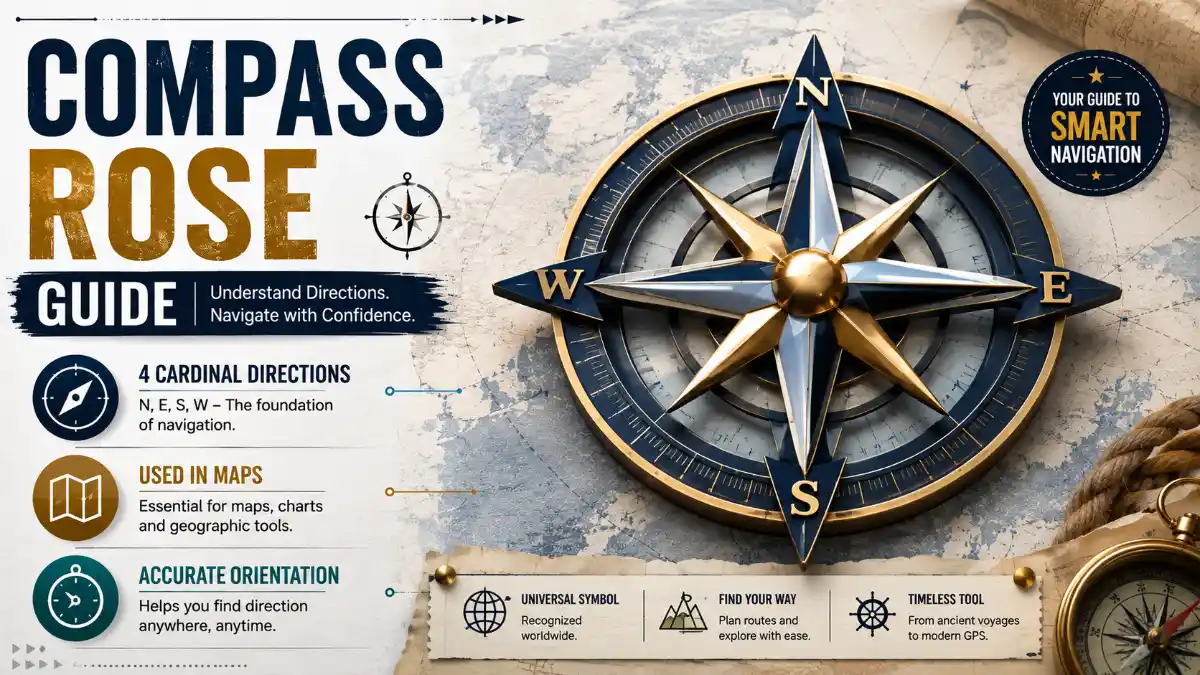
A compass rose has a center point and directional points showing the four cardinal directions: north, east, south, and west. An 8-point compass rose also includes northeast, southeast, southwest, and northwest. More detailed designs may add degree markings, additional compass points, and navigation references.
Understanding these components isn’t just a geography exercise – it’s the foundation for reading any map accurately, from a classroom atlas to a nautical chart. This guide breaks down each part of a compass rose, explains how cardinal and intermediate directions relate to one another, and shows how the symbol scales up into more detailed navigation formats.
The Anatomy of a Compass Rose
Labeled parts of an 8-point compass rose showing cardinal and intercardinal directions: the center point anchors eight directional arms.
Compass roses share the same basic directional structure, while additional features vary depending on the map’s purpose and level of detail.
| Part | What It Means |
| Center point | The fixed origin from which all directions radiate |
| Directional points/arms | The visual lines or triangles pointing toward each direction |
| Cardinal points | North, East, South, West |
| Intermediate points | Northeast, Southeast, Southwest, Northwest |
| Degree markings | Numeric bearings from 0° to 360°, found on more detailed designs |
| North indicator | A star, arrow, or fleur-de-lis marking north for quick identification |
Not every compass rose includes all of these features. A simple classroom map may show only the four cardinal points, while a nautical chart might include degree markings and a decorative north indicator as well.
Cardinal Directions vs. Intermediate Directions
| Type | Directions | Number | Spacing |
| Cardinal | North, East, South, West | 4 | 90° apart |
| Intermediate | Northeast, Southeast, Southwest, Northwest | 4 | Halfway between cardinal points |
Read More: Compass Rose
Cardinal directions are the four main points of a compass rose, spaced at perfect right angles from one another. Intermediate directions, also called intercardinal directions, fill the diagonal gaps between them, describing locations that don’t align with a single cardinal direction. Together, these eight points form an 8-point compass rose, a common format for basic map-reading and geography education.
How to Read a Compass Rose
- Find the compass rose on the map. It’s usually a small circular or star-shaped symbol in a corner.
- Identify north. Look for the “N” label, the tallest arm, or a star or fleur-de-lis marking.
- Locate east, south, and west relative to north. Moving clockwise from north, each sits 90 degrees apart.
- Use the intermediate points for in-between positions. Northeast, southeast, southwest, and northwest cover the diagonal space.
- Check for degree markings if precision matters. These let you read an exact bearing instead of estimating.
Practical Example
On a trail map, a lake sits north of the trailhead, and a lookout tower sits east of the lake. From the trailhead, the tower lies generally northeast, because it is both north and east of the starting point.
Comparing Compass Rose Formats
| Format | Points Shown | Angle Between Points |
| Minimal | 4 (cardinal only) | 90° |
| Standard | 8 (cardinal + intermediate) | 45° |
| Detailed | 16 | 22.5° |
| Traditional/nautical | 32 | 11.25° |
The 16-point format adds eight secondary intermediate directions – NNE, ENE, ESE, SSE, SSW, WSW, WNW, NNW – by splitting each 8-point gap in half. The 32-point format repeats that process again, producing the detailed design historically associated with nautical charts, where each point carries a traditional name such as “north by east.”
Advanced Compass Rose Features
The following elements go beyond basic map reading and become more relevant in navigation, surveying, and marine contexts.
Bearings and Degree Markings
A bearing is a direction expressed in degrees, measured clockwise from north around a 360-degree circle: 0° is north, 90° is east, 180° is south, and 270° is west. Degree bearings provide precise numeric equivalents for compass directions. Adjacent points on a 16-point compass rose are 22.5° apart, while adjacent points on a 32-point rose are 11.25° apart.
A note on precision: describing a location as “northeast” reflects a general relationship – it lies both north and east of a reference point – but it doesn’t always correspond to an exact 45° bearing. When precision matters, measuring the actual angle between two points is more accurate than combining cardinal directions.
True North, Magnetic North, and Grid North
| Type of North | What It Refers To | Fixed or Variable |
| True north | The geographic North Pole | Fixed |
| Magnetic north | The direction a compass needle aligns to, based on Earth’s magnetic field | Shifts over time and by location |
| Grid north | The direction of a map’s vertical coordinate grid lines | Varies slightly by map projection |
On many nautical charts, a compass rose provides both true and magnetic direction references. The true-direction scale is aligned with geographic north, while magnetic information allows navigators to account for local magnetic variation when converting between true and magnetic bearings. This angular difference is called magnetic declination, and it changes depending on location and drifts gradually over time as Earth’s magnetic field shifts. For everyday map reading, this distinction rarely matters – it becomes relevant mainly in hiking navigation, marine charts, and land surveying.
Compass Rose vs. Physical Compass
A compass rose is a static, printed symbol showing a map’s fixed orientation. A physical compass is a handheld instrument whose needle aligns with Earth’s local magnetic field in real time. Used together, they let you match a map’s printed directions to your actual surroundings by aligning the compass needle with the map’s north indicator.
Frequently Asked Questions
What are the main parts of a compass rose called?
The main parts are the center point, directional points or arms, and the labeled directions themselves – cardinal points (N, E, S, W) and, on more detailed designs, intermediate points (NE, SE, SW, NW). Some compass roses also include degree markings and a decorative north indicator, such as a star or fleur-de-lis.
Do all compass roses have the same parts?
No. A basic compass rose may show only the four cardinal points, while more detailed versions add intermediate points, secondary intermediate points, degree markings, and sometimes dual references distinguishing true north from magnetic north. The parts present depend on how much precision the map’s purpose requires.
What’s the difference between a directional point and a cardinal point?
A directional point refers generally to any labeled point on the compass rose, including cardinal, intermediate, or secondary intermediate directions. A cardinal point specifically refers to one of the four main directions – north, east, south, or west – spaced 90 degrees apart.
Why do some compass roses include degree markings and others don’t?
Degree markings appear on compass roses designed for precise navigation, such as nautical charts, where exact bearings matter for plotting a course. Simpler educational or everyday maps often skip degree markings, since naming cardinal and intermediate directions is sufficient for general orientation.
What is the center point of a compass rose used for?
The center point is the fixed origin from which every directional arm radiates outward. It doesn’t represent a specific direction itself – it’s the reference point that all directional labels, whether cardinal, intermediate, or degree-based, are measured relative to.
How can I tell which part of the compass rose represents north?
North is typically the most emphasized part of the design, often marked with the letter “N,” the longest arm, or a decorative symbol like a star or fleur-de-lis. Identifying north first is the standard first step in reading any compass rose, since every other direction is determined relative to it.