
God’s Provision and the Righteous: “Never Seen the Righteous Forsaken” – Psalm 37:25
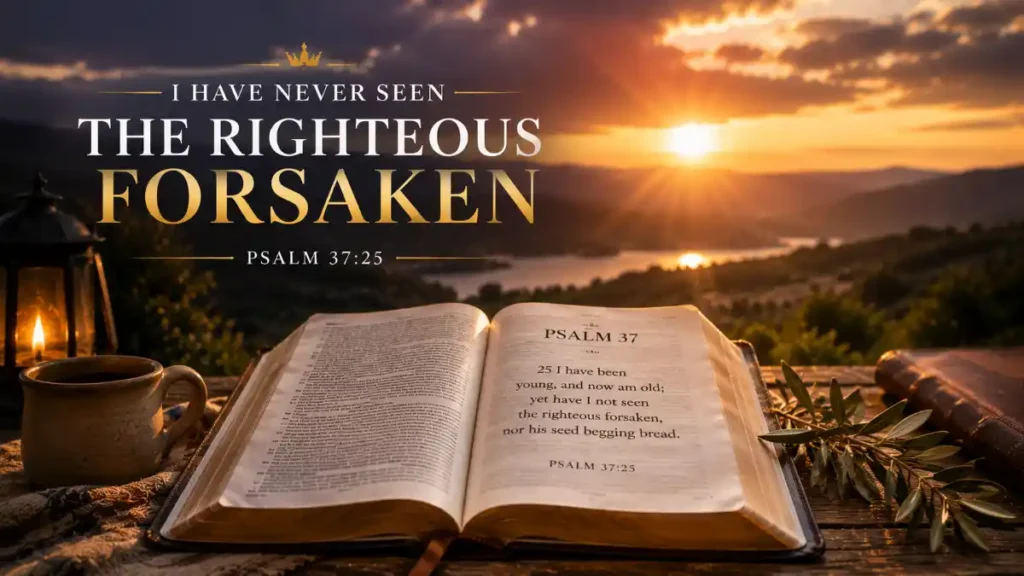
The phrase never seen the righteous forsaken comes from Psalm 37:25, one of the Bible’s best-known statements about God’s faithfulness and provision. David looks back over his life and declares that he has never seen the righteous abandoned by God or their descendants left without food. The verse offers strong encouragement, but it should not be interpreted as a promise that faithful Christians will never experience poverty, suffering, loss, or difficult seasons.
Psalm 37:25 makes more sense when read in the context of the entire psalm. David is addressing a difficult question: Why do wicked people sometimes appear to prosper while people who trust God struggle? His answer is not that hardship never happens. Instead, he calls God’s people to trust the Lord, remain faithful, wait patiently, and remember that the apparent success of evil is temporary.
This makes Psalm 37:25 a powerful passage about God’s faithfulness in the middle of uncertainty, rather than a formula promising financial prosperity.
What Does “Never Seen the Righteous Forsaken” Mean?
Never seen the righteous forsaken means that David’s lifelong experience gave him confidence that God does not ultimately abandon those who belong to Him. Psalm 37:25 describes God’s faithfulness and provision while still allowing for seasons of hardship, stumbling, opposition, and need.
The surrounding verses are important. Psalm 37:23–24 says that the Lord establishes the steps of the righteous and holds them when they stumble. Verse 25 then gives David’s personal testimony, while verse 26 describes the righteous as generous and their children as blessed.
So the central message is not:
“A righteous person will never experience financial trouble.”
It is closer to:
“God remains faithful to His people, even when their circumstances are difficult.”
That distinction protects Psalm 37:25 from being turned into a simplistic promise of guaranteed wealth.
Psalm 37:25: The Bible Verse Behind the Quote
Psalm 37:25 is traditionally associated with David and is part of a wisdom psalm that contrasts the temporary success of the wicked with the enduring security of those who trust God. The NIV renders the central statement as David saying that he was young and became old, yet had never seen the righteous forsaken or their children begging for bread.
The KJV famously uses the wording “I have been young, and now am old; yet have I not seen the righteous forsaken”, followed by the reference to his descendants and bread.
Different Bible translations use terms such as righteous, godly, forsaken, abandoned, children, descendants, or offspring. These wording differences do not change the main idea of David’s testimony. The underlying Hebrew term translated as “seed” can refer to offspring or descendants, which explains why modern translations commonly use “children” or “descendants.”
Read More: Never Seen the Righteous Forsaken
What Does “Forsaken” Mean in Psalm 37:25?
In this context, “forsaken” describes abandonment rather than the temporary experience of hardship.
That distinction is crucial.
The Bible does not present faithful people as immune from trouble. Psalm 37 itself acknowledges that the righteous can stumble. Yet the psalm immediately adds that the Lord holds them by the hand. Later, Psalm 37:39–40 describes God as delivering and protecting His people in times of trouble.
Therefore, being “not forsaken” does not mean never needing help. It means that difficulty does not prove God’s absence.
Psalm 37:25 Meaning in Context
To understand Psalm 37:25 correctly, begin with Psalm 37:1.
The psalm opens by telling God’s people not to fret or envy evildoers because of their apparent success. Verse 2 compares their prosperity to grass that quickly withers. The psalm then repeatedly encourages trust, patience, obedience, and confidence in God’s ultimate justice.
This establishes the central tension of Psalm 37:
The wicked may appear successful for a season, while the righteous may experience difficulty, but appearances do not determine the outcome.
David’s statement in verse 25 supports that argument.
He is looking backward rather than merely making an abstract theological statement. He says, in effect, “I have lived long enough to observe God’s dealings with His people, and my experience has taught me that God does not abandon the righteous.”
That makes the verse both theological and personal.
Psalm 37 Is About More Than Money
Because Psalm 37:25 mentions descendants seeking bread, readers sometimes treat the verse as primarily a financial promise.
But the larger psalm is broader.
Psalm 37 discusses:
- apparent prosperity among evildoers
- envy and anxiety
- trusting God
- doing what is right
- waiting patiently
- God’s justice
- the inheritance of the righteous
- generosity
- stumbling and restoration
- God’s protection
- the ultimate disappearance of wickedness
The NET notes that Psalm 37 is an acrostic poem and presents its central concern as the contrast between the apparent success of sinners and God’s preservation of the godly.
Psalm 37:25 therefore belongs to a much larger message about trusting God’s character when circumstances appear unfair.
What “Righteous” Means in Psalm 37:25
The word “righteous” should not be understood as describing people who have never sinned or made mistakes.
Biblically, righteousness involves living in faithful relationship with God and walking according to His ways.
Psalm 37 repeatedly contrasts the righteous with the wicked. The righteous trust God, do good, maintain integrity, show compassion, and wait for the Lord. The wicked, by contrast, scheme against others and place their confidence in their own power or apparent success.
This matters because Psalm 37:25 is not teaching that morally perfect people receive automatic material rewards.
Instead, the verse is part of wisdom literature describing the contrasting paths of those who trust God and those who reject His ways.
Read More: Never Seen the Righteous Forsaken
Why Psalm 37:24 Helps Explain Verse 25
Psalm 37:24 provides an important safeguard against misunderstanding the next verse.
The psalm says that even when the righteous stumble, they will not ultimately fall because the Lord upholds them.
That means verse 25 should not be read as:
“The righteous never have problems.”
The surrounding context says something more nuanced:
“The righteous may stumble, but God does not abandon them.”
This is one of the most encouraging aspects of Psalm 37.
Faith does not eliminate every difficult circumstance. God’s presence gives believers a reason to remain faithful when circumstances become difficult.
What Does “His Seed Begging Bread” Mean?
Older translations such as the KJV use the word “seed,” while many modern translations use “children” or “descendants.”
The Hebrew expression refers to offspring, and the immediate context connects the righteous with generosity and blessing. The NET notes that “seed” can be understood as “offspring” and that the expression concerning searching for food refers to the experience of being forced to seek food.
The image communicates vulnerability and lack.
Bread represents basic sustenance. David is describing a situation in which the descendants of the righteous are reduced to desperately searching for food.
The point is therefore not that every righteous family will always experience financial abundance. The verse expresses David’s testimony concerning God’s long-term care and faithfulness.
Five Lessons From Psalm 37:25
Psalm 37:25 becomes especially meaningful when connected to the practical instructions surrounding it.
1. Trust God When Other People Seem to Be Winning
Psalm 37 begins by confronting envy.
That remains relevant today. It is easy to look at another person’s money, career, possessions, influence, or apparent success and conclude that faithfulness is not worthwhile.
Psalm 37 challenges that conclusion.
The psalm reminds readers that visible success is not the same as lasting blessing. What appears impressive for a moment may disappear just as quickly as grass in the field.
2. Do Not Interpret Every Hardship as God’s Abandonment
Financial difficulty, unemployment, disappointment, or an uncertain future can create the feeling that God has forgotten someone.
Psalm 37:25 provides a different perspective.
A difficult season is not automatically evidence that God has abandoned you. The verse needs to be read alongside verse 24, where the righteous can stumble while still being upheld by God.
That distinction can prevent unnecessary guilt and spiritual despair.
3. Wait Without Giving Up Your Faithfulness
Psalm 37 repeatedly tells its readers to wait for the Lord.
Waiting is not presented as passive hopelessness. It is connected with trusting God, doing good, maintaining integrity, and refusing to be consumed by anger or envy.
The lesson is simple:
Do not let someone else’s temporary success determine your faithfulness.
4. Let Confidence in God’s Provision Produce Generosity
Verse 26 immediately follows David’s testimony and describes the righteous as compassionate and generous.
That connection is significant.
Biblical confidence in God’s provision is not supposed to create selfishness. It should produce generosity, compassion, and willingness to help others.
The person who trusts God does not have to treat every resource as something that must be protected at all costs.
5. Never Use the Verse to Judge Someone Else’s Poverty
This may be one of the most important applications.
If Psalm 37:25 is misunderstood as a rigid financial guarantee, people may conclude that someone experiencing poverty must be unrighteous or lacking faith.
That conclusion goes beyond the verse.
Scripture contains numerous examples of faithful people experiencing suffering, persecution, loss, hunger, uncertainty, and hardship. Psalm 37:25 should therefore encourage people who are struggling rather than become a weapon for judging them.
Read More: Never Seen the Righteous Forsaken
Is Psalm 37:25 a Promise of Financial Prosperity?
No. Psalm 37:25 should not be treated as a guarantee that every faithful person will become wealthy or avoid financial hardship.
The verse speaks about God’s faithfulness and provision, but the Bible does not teach a simple equation in which righteousness automatically produces material wealth.
In fact, Psalm 37 itself describes the righteous as people who can stumble. It also repeatedly calls them to wait, trust, endure opposition, and remain faithful while wicked people appear successful.
This is why Psalm 37:25 should not be isolated from the rest of Scripture.
God’s provision can involve material needs, but biblical provision is larger than wealth. It includes God’s presence, protection, guidance, sustaining grace, community, daily necessities, and ultimately the hope of His lasting kingdom.
Bible Verses About God’s Provision and Faithfulness
Psalm 37:25 is one part of a much larger biblical theme.
Deuteronomy 31:6
Moses encourages Israel to be strong and courageous because God will not fail or forsake His people.
This passage is especially relevant when studying the biblical language of God’s faithfulness.
Hebrews 13:5
Hebrews applies similar language of God’s presence and faithfulness to Christians, encouraging believers to be content rather than controlled by the love of money.
This is an important connection because it shows that biblical confidence in God’s provision is closely related to contentment.
Matthew 6:25–34
Jesus addresses anxiety about food, drink, and clothing. Rather than denying that physical needs exist, He teaches His followers not to be consumed by worry and points them toward trust in God.
Psalm 34:10
Psalm 34 uses another memorable expression about those who seek the Lord not lacking what is good.
This passage complements Psalm 37 by emphasizing God’s care while still requiring readers to understand “good” according to the broader biblical context.
Philippians 4:19
Paul tells the Philippians that God will supply their needs according to His riches in Christ.
The verse is encouraging, but its context also includes Paul’s experience of both abundance and need. That makes it another example of why biblical provision should not be reduced to guaranteed material prosperity.
Read More: Never Seen the Righteous Forsaken
How Psalm 37:25 Can Encourage Someone in a Difficult Season
The verse becomes especially powerful when life does not look secure.
Someone may be facing unemployment, debt, an uncertain future, family pressure, or another form of hardship. In such moments, quoting the verse as though it guarantees an immediate financial breakthrough can create disappointment.
A better approach is to receive its deeper encouragement.
God’s faithfulness does not depend on today’s circumstances.
Psalm 37 does not tell the reader to pretend that evil does not exist. It openly acknowledges that wicked people can appear successful. It does not tell the righteous that they will never stumble. It explicitly says that they can fall. Instead, it directs attention back to God.
Trust Him.
Do good.
Wait patiently.
Do not envy.
Do not surrender your integrity.
That is the spiritual direction of the psalm.
What “Never Seen the Righteous Forsaken” Does Not Mean
A careful reading should also identify what the phrase does not promise.
It does not mean:
- Christians will never experience poverty.
- Faithful people will never lose employment.
- Every financial problem will disappear quickly.
- Every righteous family will become wealthy.
- Suffering proves someone has failed God.
- God will give believers everything they want.
- A person can use the verse as a guarantee of a specific financial outcome.
Instead, Psalm 37:25 points toward confidence in God’s long-term faithfulness.
That distinction is essential for a healthy Christian understanding of the verse.
Frequently Asked Questions
What does “never seen the righteous forsaken” mean?
It means that David, looking back over his life, testified that he had not witnessed God ultimately abandon the righteous or leave their descendants without basic provision. The statement emphasizes God’s faithfulness rather than promising a life without hardship.
Where does “never seen the righteous forsaken” come from?
The phrase comes from Psalm 37:25 in the Bible. It is part of a psalm traditionally attributed to David and is spoken as a reflection on his experience from youth to old age.
What is the main message of Psalm 37?
Psalm 37 teaches God’s people not to envy wicked people who appear successful. Instead, it calls them to trust God, do what is right, wait patiently, and remain confident that evil does not have the final word.
Does “seed” in Psalm 37:25 mean children?
Yes. The Hebrew term can refer to offspring or descendants. This is why modern Bible translations commonly use “children” or “descendants,” while older translations such as the KJV use “seed.”
Does Psalm 37:25 promise that Christians will never be poor?
No. The verse should not be interpreted as a guarantee of permanent financial prosperity. It is David’s testimony concerning God’s faithfulness and provision within the broader message of Psalm 37.
Why is Psalm 37:24 important when reading Psalm 37:25?
Verse 24 says that the righteous can stumble but will not ultimately be abandoned because the Lord holds them. This helps explain that “not forsaken” does not mean “never experiencing difficulty.”
What does Psalm 37:25 teach about God’s provision?
It teaches confidence in God’s continuing care for His people. The passage places that confidence within a larger call to trust, patience, righteousness, generosity, and dependence on God.
What Bible verses are similar to Psalm 37:25?
Helpful passages for comparison include Deuteronomy 31:6, Hebrews 13:5, Matthew 6:25–34, Psalm 34:10, and Philippians 4:19. Each addresses God’s faithfulness or care from a somewhat different context.
Can Psalm 37:25 be used to judge someone experiencing financial hardship?
No. The verse should not be used to conclude that financial hardship proves a person’s lack of faith or righteousness. Such a conclusion goes beyond what Psalm 37:25 actually says.
How can I apply Psalm 37:25 today?
Use it as an encouragement to trust God’s character when circumstances are uncertain. Resist envy, remain faithful, practice generosity, seek God rather than material security, and remember that a difficult season does not automatically mean that God has abandoned you.







1 thought on “God’s Provision and the Righteous: “Never Seen the Righteous Forsaken” – Psalm 37:25 ”