Are Jeans Business Casual? Can You Wear Jeans to a Business Casual Job?
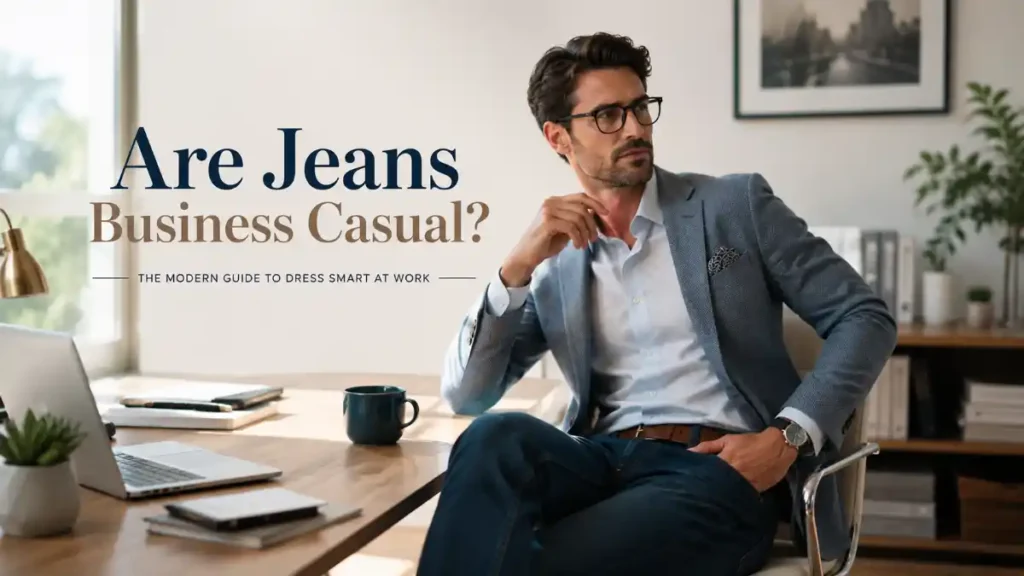
If you are asking whether jeans are business casual, you are probably not looking for a fashion rule. You are trying to understand “Are Jeans Business Casual” in a real workplace context so you can avoid making the wrong professional decision.
That distinction matters.
A pair of dark jeans may be completely normal at one company and clearly outside the dress code at another. Even within the same organization, denim may be fine for an ordinary workday but inappropriate for an interview, client presentation, recruiting event, or formal dinner.
Current guidance reflects that inconsistency. Indeed says jeans can be part of business casual in some workplaces, particularly when they are dark, clean, and free from rips. Other career organizations use stricter definitions and place jeans under smart casual instead.
So instead of searching for one universal rule, use a workplace decision framework.
The Real Question Behind “Are Jeans Business Casual?”
The real question is usually:
“Can I wear jeans here without appearing underdressed for my role and today’s situation?”
That question has several variables.
Employer Policy
The written dress code is your strongest starting point.
If the policy says jeans are permitted, you have a clear baseline.
If it says jeans are prohibited, do not reinterpret the rule because a fashion website says dark denim can look professional.
If the policy does not mention jeans, ask.
Indeed’s current guidance recommends consulting the official company dress code and learning from what employees actually wear.
Workplace Culture
The written rule may not tell you how formal different departments are.
A technology company can have a casual engineering team and a more formal sales organization. A creative agency can allow expressive clothing while still expecting polished client-facing outfits.
Look for patterns among people in comparable roles.
Occasion
This is where many otherwise good clothing decisions fail.
Normal workday:
Potentially jeans.
Interview:
Usually choose something more formal.
Client meeting:
Depends on client and employer expectations.
Formal event:
Follow the event-specific instructions.
The same company can legitimately have different clothing expectations for each.
Read More: Are Jeans Business Casual
A Simple Hierarchy for Making the Decision
When you are uncertain, evaluate clothing in this order:
1. Company policy
2. Specific event instructions
3. Workplace culture
4. Role and audience
5. Denim and outfit
This order matters.
Many people start with the jeans:
“These are dark, so surely they are professional.”
That reverses the decision.
Dark jeans can improve the appearance of permitted denim. They cannot make prohibited denim acceptable.
What Does Business Casual Actually Mean?
Business casual generally combines professional presentation with less formal clothing than a traditional business-professional wardrobe.
Indeed describes business casual as traditional business wear blended with a more relaxed style while maintaining a professional appearance.
That leaves room for interpretation.
Why Smart Casual Creates Confusion
Smart casual is usually more relaxed and fashion-oriented than business casual. Indeed notes that jeans are commonplace within smart-casual dress.
That is why an employer that says “smart casual” may be more clearly signaling that denim is welcome.
But terminology is not standardized enough to rely on labels alone.
If your company uses “business casual” and “smart casual” differently, follow its own definitions.
Why Business Professional Is Different
Business professional is more formal and traditional.
Indeed identifies banking, accounting, law, government, and finance among industries where business-professional clothing is commonly used.
This does not mean every employer in those industries follows the same rule.
It means the cost of assuming jeans are acceptable is generally higher in traditionally formal environments.
Read More: Are Jeans Business Casual
The First-Week Rule: Do Not Test the Limits Immediately
If you are starting a new job and wondering whether jeans are business casual, resist the temptation to experiment on day one.
Instead, dress slightly more formally and observe.
Look at:
- Managers
- Senior colleagues
- People in your role
- People attending your meetings
- What changes on client days
- What people wear on Fridays
- Whether different departments follow different norms
Indeed’s current guidance recommends dressing more formally during the first few days of a new role so you can observe and adjust.
This is a simple information-gathering strategy.
You are not committing to trousers forever. You are buying yourself time to understand the environment.
What Different Workplace Environments Tell You
Industry should not be treated as a hard rule, but it can help you estimate the level of caution needed.
Traditional Professional Environments
Banking, law, finance, and similar fields can have more formal expectations.
Indeed’s current business-professional guidance identifies several of these sectors as commonly using traditional professional attire.
If your employer explicitly allows jeans, follow the policy. If it does not, trousers or chinos are the safer starting point.
Technology and Startups
Tech and startup workplaces can be considerably more relaxed.
Indeed’s business-casual guidance specifically recognizes that creative agencies and technology firms may have more flexible clothing cultures.
But casual culture does not mean every occasion has the same dress requirement.
A startup employee might wear jeans every day and still dress more formally for a client presentation or interview.
Creative Industries
Design, advertising, media, and related environments can allow more personal expression.
Here, the question may be less about whether denim exists and more about whether your particular styling fits the workplace.
Still, client-facing responsibilities can change the answer.
The Denim Risk Ladder
Once jeans are allowed, you can evaluate how conservative or casual a particular pair appears.
| Denim choice | Relative workplace risk |
| Dark, clean, intact denim | Lower |
| Black, clean denim | Lower |
| Medium wash, intact denim | Moderate |
| Light wash | Higher in conservative offices |
| Heavy fading | Higher |
| Ripped denim | High |
| Large embellishments | High |
| Very distressed denim | High |
Read More: Are Jeans Business Casual
This is a styling risk scale, not an official dress-code classification.
A workplace that explicitly welcomes fashion-forward denim may treat some of the higher-risk options as normal.
The “Important Meeting” Test—With a Better Question
A useful thought experiment is to imagine yourself walking into an important professional meeting.
But do not ask:
“Would these jeans work at any client meeting?”
That assumes every workplace has the same client standard.
Instead ask:
“Would this outfit match the level of professionalism expected from me in today’s most important interaction?”
If the answer is yes, the outfit may be appropriate.
If the answer is uncertain, trousers remove the uncertainty.
When Jeans Are Usually a Poor Default
Interviews
Interview clothing should be evaluated separately from normal workplace clothing.
Indeed recommends formal pants rather than denim for interviews.
Kellogg at Northwestern also recommends researching the employer and dressing at the same level or slightly above the people you are meeting. Its guidance specifically recommends business-casual attire even when interviewing at informal startups where jeans and T-shirts are common during ordinary work.
So if you are considering jeans because “everyone at the company wears them,” that is not enough evidence for an interview.
Career Fairs and Recruiting Events
Do not assume your future office’s everyday dress code applies to a recruiting event.
Event-specific instructions take priority.
If the organizer says business casual, follow that definition. If jeans are not explicitly included and you are uncertain, choose trousers.
Client Meetings
Your internal culture may be casual while your client is formal.
When the client relationship matters, and expectations are unclear, dress slightly more formally.
Presentations to Senior Leadership
A normal office day and a high-visibility presentation are not necessarily equivalent.
Look at what people normally wear for similar presentations at your organization.
How to Ask About Jeans Without Making It Awkward
You do not need to make the conversation complicated.
A useful question is:
“Does business casual here include dark, non-distressed jeans on normal office days?”
That is much more useful than asking for an abstract definition of business casual.
If the answer is yes, you now know that denim is permitted.
You can then determine which styles fit the local norm.
What If the Handbook and Reality Do Not Match?
This can happen.
Suppose the handbook says “business casual,” but everyone in your department wears dark jeans.
Do not immediately conclude that the written policy is irrelevant.
Instead:
- Confirm whether there is a department-specific rule.
- Ask your manager or HR.
- Check whether jeans are restricted on certain days or for certain roles.
- Determine whether client meetings have different standards.
Conversely, if the handbook says jeans are permitted, but everyone in your role wears trousers, you may want to understand why.
Perhaps your department has a more formal client expectation.
The goal is not to find loopholes. It is to understand the actual professional expectation.
When Dark Jeans Make Sense
If your employer clearly allows denim, dark jeans are a practical place to start.
Indeed’s current guidance identifies dark-wash and black jeans as suitable business-casual options where jeans are accepted and recommends avoiding rips and fraying.
A sensible outfit could be:
dark jeans + button-down + loafers
or:
black jeans + blouse + blazer + flats
The outfit should look intentional without pretending to be formal businesswear.
Fit Matters, But There Is No Single Approved Cut
Straight-leg and bootcut are commonly suggested office options, but you should not treat them as the only acceptable cuts.
The more useful standard is:
- Comfortable
- Clean
- Appropriate to the workplace
- Not excessively distressed
- Not distracting
- Compatible with the rest of the outfit
A fashion-conscious workplace may accept silhouettes that would look unusual in a conservative office.
A Decision Chart for Real-World Situations
| Situation | Best approach |
| Employer explicitly allows jeans | Wear appropriate denim |
| Employer prohibits jeans | Choose chinos or trousers |
| Dress code unclear | Ask before wearing denim |
| First days at a new job | Start slightly more formally |
| Casual Friday explicitly permits jeans | Follow the stated policy |
| Normal day in a relaxed office | Jeans may work |
| Important client meeting | Consider a dressier option |
| Interview | Usually choose formal trousers |
| Recruiting event | Follow event instructions |
| Formal company dinner | Usually move one level more formal |
Read More: Are Jeans Business Casual
Indeed also notes that jeans may be appropriate for some normal office situations but inappropriate for conferences and other events.
What to Wear Instead of Jeans
Sometimes the best answer is to remove the uncertainty.
Chinos
Chinos are an excellent middle ground.
They are less formal than many dress trousers but generally carry fewer denim-specific restrictions.
Tailored Trousers
Choose tailored trousers when:
- The office is conservative
- The policy is unclear
- You are meeting a formal client
- You are interviewing
- You are attending an important professional event
Business-Professional Clothing
For formal interviews or settings that explicitly call for business professional, follow the stated dress code rather than trying to adapt denim.
Why “Overdressing Is Safer” Needs a Qualification
The advice to overdress is useful, but it should not be interpreted as “always dress as formally as possible.”
If everyone in a casual startup wears jeans and you arrive in a full formal suit every day, you may simply be out of step with the culture.
The better rule is:
When you are uncertain, choose the more formal side of the range—not the most formal outfit imaginable.
Kellogg’s interview guidance similarly recommends dressing at the same level or slightly above the people you are meeting.
A Five-Point Jeans Check
Before leaving for work, ask:
Policy: Are jeans permitted?
Condition: Are they clean and intact?
Fit: Do they fit comfortably and look intentional?
Balance: Are the rest of my clothes appropriate for the workplace?
Occasion: Is today more formal than an ordinary workday?
If the first answer is “no,” choose different pants.
If the first answer is “I don’t know,” ask or choose the safer alternative.
Frequently Asked Questions
Are jeans business casual at a new job?
They can be, but do not assume they are. Check the company’s policy and observe colleagues in comparable roles before making denim your normal workwear.
Should I wear jeans on my first day?
If the dress code is unclear, a slightly more formal outfit is safer. Once you understand the workplace norm, you can adjust.
Do conservative industries allow business casual jeans?
Some employers may, but there is no universal industry-wide rule. Traditional professional sectors often have stricter expectations, so follow the individual employer’s policy.
Can I wear jeans to a client meeting?
Possibly, if your employer and client context support it. If you cannot determine the expected level of formality, chinos or tailored trousers are safer.
Are dark jeans always business casual?
No. Dark denim is simply a conservative-looking option when jeans are permitted. It does not override a workplace policy.
Can jeans be smart casual but not business casual?
Yes. Dress-code terminology varies, but smart casual is generally more relaxed and often incorporates jeans more readily than a conservative interpretation of business casual.
Are ripped jeans appropriate for business casual?
Usually not. They create a stronger casual signal and are often excluded from professional dress codes.
Can I wear jeans to a startup interview?
Do not assume so. Even informal startups may expect candidates to dress more formally for interviews. Kellogg’s guidance specifically recommends business-casual interview attire for startup environments.
What if my manager wears jeans but my colleagues wear trousers?
That may indicate different expectations by role or occasion. Ask for clarification rather than copying one person.
What is the safest alternative to jeans?
Chinos are a useful middle ground for ordinary business-casual situations. Tailored trousers are safer when the workplace or event is more formal.