
Tibialis Anterior Exercises: How to Strengthen Your Shins
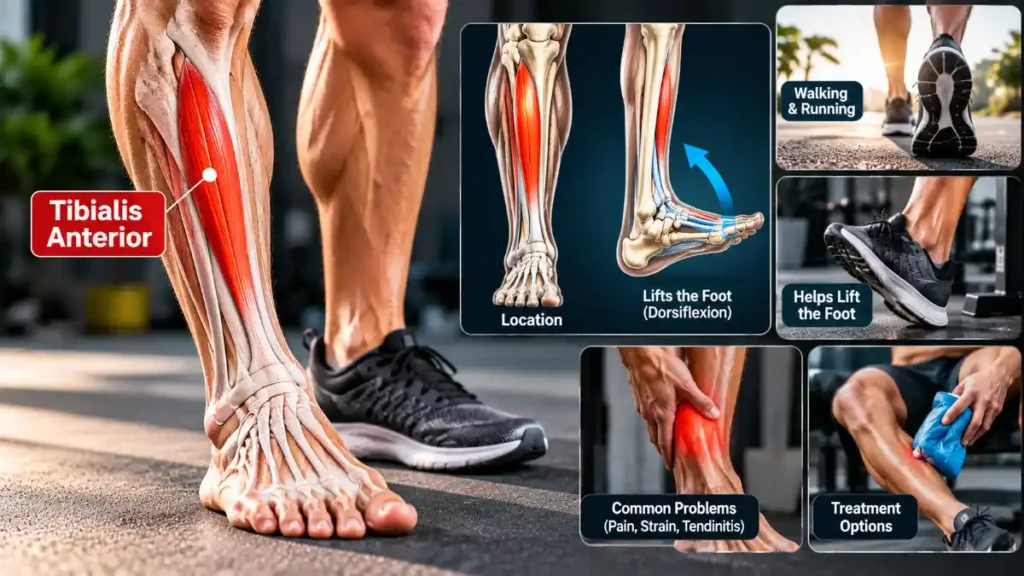
The best way to strengthen the tibialis anterior is to perform controlled exercises that lift the front of your foot toward your shin. Effective options include wall tibialis raises, seated or standing tibialis raises, resistance-band dorsiflexion, and controlled heel walking. Beginners can start with bodyweight movements two or three times per week, then gradually increase repetitions or resistance as their technique improves.
A practical routine combines proper exercise form with manageable training volume and adequate recovery. Keep your heels planted during raises, lower your feet slowly, and avoid using momentum. Pairing tibialis anterior exercises with calf strengthening, ankle mobility, and general lower-body conditioning helps train different aspects of lower-leg function. These exercises can build strength, but they do not guarantee injury prevention or improved athletic performance.
Best Tibialis Anterior Exercises
1. Wall Tibialis Raises
Wall tibialis raises are a convenient starting point because they require no equipment. You can adjust the difficulty by changing your distance from the wall.
How to perform them:
- Stand with your back against a wall and your feet approximately 6–12 inches forward.
- Keep your heels firmly on the floor, and your knees relaxed rather than locked.
- Lift your toes and forefeet toward your shins without lifting your heels.
- Pause briefly at the top, then lower your forefeet slowly.
- Repeat without bouncing or using momentum.
Common mistakes: Leaning excessively backward, lifting the heels, and rushing the lowering phase can reduce control. Start closer to the wall if necessary, then move your feet farther forward when you can complete the movement comfortably.
2. Seated or Standing Tibialis Raises
Seated raises offer a stable option for beginners, while standing raises provide a bodyweight alternative for people who can maintain their balance.
How to perform them:
- Sit on a sturdy chair with your feet flat on the floor and your knees comfortably bent.
- Keep your heels down and lift the front of both feet toward your shins.
- Pause briefly, then lower your toes under control.
- For the standing variation, remain upright and use a wall or stable support if needed.
Common mistakes: Rocking your body, lifting your heels, or bouncing through repetitions can reduce the exercise’s effectiveness. Focus on movement at the ankles rather than swinging your legs. Progress to standing raises when you can perform seated repetitions smoothly.
3. Resistance-Band Dorsiflexion
Resistance-band dorsiflexion allows you to adjust the challenge as your strength improves. It is useful when bodyweight raises become relatively easy.
How to perform it:
- Sit with one leg extended comfortably in front of you.
- Secure a resistance band to an anchor that will not move under tension, and loop the other end around your forefoot.
- Position your foot so the band provides light resistance.
- Pull your toes toward your shin without twisting your foot or moving your knee.
- Return slowly to the starting position, resisting the band’s pull.
Common mistakes: Using excessive resistance, allowing the band to snap back, or moving the entire leg instead of the ankle can compromise control. Check the band and anchor before each set. Begin with light resistance and increase it only when you can complete every repetition with consistent technique.
4. Controlled Heel Walking
Heel walking challenges the muscles that lift the forefoot while you move. It also requires balance and coordination, making it a useful complement to stationary raises.
How to perform it:
- Stand upright near a wall or other stable support.
- Lift your toes so your weight rests on your heels.
- Take small, controlled steps while keeping your forefeet raised.
- Continue for a short interval at a comfortable pace.
- Lower your feet normally and rest before repeating.
Common mistakes: Taking long strides, letting your toes drop, leaning too far backward, or continuing after your technique deteriorates can make the movement harder to control. Start with short intervals on a flat, clear surface. If balance is difficult, use support or begin with seated raises.
Beginner Tibialis Anterior Workout Routine
Start with a manageable workload rather than performing every exercise at maximum effort. The following routine is a general starting point for healthy adults who can exercise comfortably, not an individualized rehabilitation prescription.
| Exercise | Starting dose | Rest |
| Wall tibialis raises | 2 sets of 10–15 reps | 45–60 seconds |
| Resistance-band dorsiflexion | 2 sets of 10–12 reps per foot | 45–60 seconds |
| Controlled heel walking | 2 bouts of 10–20 seconds | 45–60 seconds |
| Calf raises | 2 sets of 10–15 reps | 45–60 seconds |
Begin with two or three sessions per week on nonconsecutive days. Rest between sets, and reduce repetitions if you cannot maintain controlled movement. You can alternate wall raises and band dorsiflexion across sessions if completing the entire routine feels excessive.
The American Academy of Orthopaedic Surgeons (AAOS) includes ankle dorsiflexion and plantar flexion in its foot and ankle conditioning program, with three sets of 10 repetitions performed three days per week. That is a reference for the listed exercise, not proof that this entire four-exercise routine is optimal for everyone.
How to Progress Your Tibialis Training
Progress gradually instead of increasing repetitions, resistance, and training frequency all at once. The goal is to make each exercise more challenging without sacrificing technique.
- Master the basic movement: Start with seated raises or wall raises until you can lift and lower your forefeet without momentum.
- Increase repetitions: Add a few repetitions within a comfortable range when your existing sets feel manageable.
- Introduce resistance: Use a light band when bodyweight movements become easy. Increase tension in small increments.
- Improve control: Pause briefly at the top and lower your feet slowly instead of rushing through repetitions.
- Increase volume cautiously: Add a set only when your current workload is well tolerated, and recovery remains adequate.
Before progressing, make sure you can complete the planned repetitions with stable positioning, controlled lowering, and no increasing discomfort. Change one training variable at a time so you can judge how your body responds. Consistent technique and gradually increasing resistance are more useful measures of progress than chasing muscle fatigue.
Combine Tibialis Training With a Balanced Lower-Leg Routine
The tibialis anterior lifts the front of the foot, while the calf muscles contribute to pushing the foot downward. Training both movements helps develop strength across different ankle actions.
Include calf raises alongside your tibialis anterior exercises. Lift your heels smoothly, pause briefly, and lower them under control. Start with bodyweight and adjust the difficulty to your current ability.
Gentle ankle mobility work can complement strengthening. For example, perform controlled ankle circles through a comfortable range without forcing the joint. General lower-body exercises, such as squats or step-ups, can also support a broader conditioning routine when appropriate for your fitness level.
Runners and other active individuals should consider overall conditioning, recovery, and training load rather than relying on one isolated muscle. Strengthening the tibialis anterior may contribute to lower-leg strength and movement control, but it cannot guarantee injury prevention or better athletic performance.
Training Safety and Common Mistakes
Progressing too quickly is a common programming mistake. Excessive resistance, rushed repetitions, and too much training volume can make proper form harder to maintain. Start with a comfortable workload and allow recovery between sessions.
Keep your feet aligned, avoid forcing the ankle through an uncomfortable range, and use stable equipment and surfaces. Stop an exercise if it causes pain rather than ordinary muscular effort. If you already have lower-leg pain, an injury, persistent foot weakness, or difficulty lifting the front of your foot, seek guidance from a qualified healthcare professional before beginning a strengthening routine.
Frequently Asked Questions
What are the best tibialis anterior exercises for beginners?
Wall tibialis raises and seated toe raises are accessible starting options. Add resistance-band dorsiflexion and short heel-walking intervals as your strength and movement control improve.
How often should you train the tibialis anterior?
Two or three sessions per week on nonconsecutive days is a reasonable starting point for general conditioning. Adjust frequency according to your workload, recovery, and individual needs.
How many repetitions should you do for tibialis raises?
Start with two sets of 10–15 controlled repetitions. Increase the workload gradually when you can maintain consistent form without increasing discomfort.
Can you strengthen the tibialis anterior without equipment?
Yes. Wall tibialis raises, seated toe lifts, standing raises, and controlled heel walking can all be performed without weights or resistance bands.
Are wall tibialis raises better than resistance-band dorsiflexion?
Neither is universally better. Wall raises provide convenient bodyweight training, while resistance bands let you adjust the challenge more precisely as your strength develops.
How long does it take to strengthen the tibialis anterior?
Progress varies with your starting strength, consistency, training load, and recovery. Track improvements in controlled repetitions or resistance over time rather than expecting a guaranteed result by a specific date.
Should you train the tibialis anterior and calves together?
Yes. Combining forefoot raises with calf raises trains different ankle movements and helps create a more balanced lower-leg strengthening routine.
Can tibialis anterior exercises prevent shin splints?
No exercise guarantees prevention. Strengthening may be one part of conditioning, but shin pain has different possible causes and may require professional assessment.