Pitradine: The Complete Truth About a Fake Medicine Name
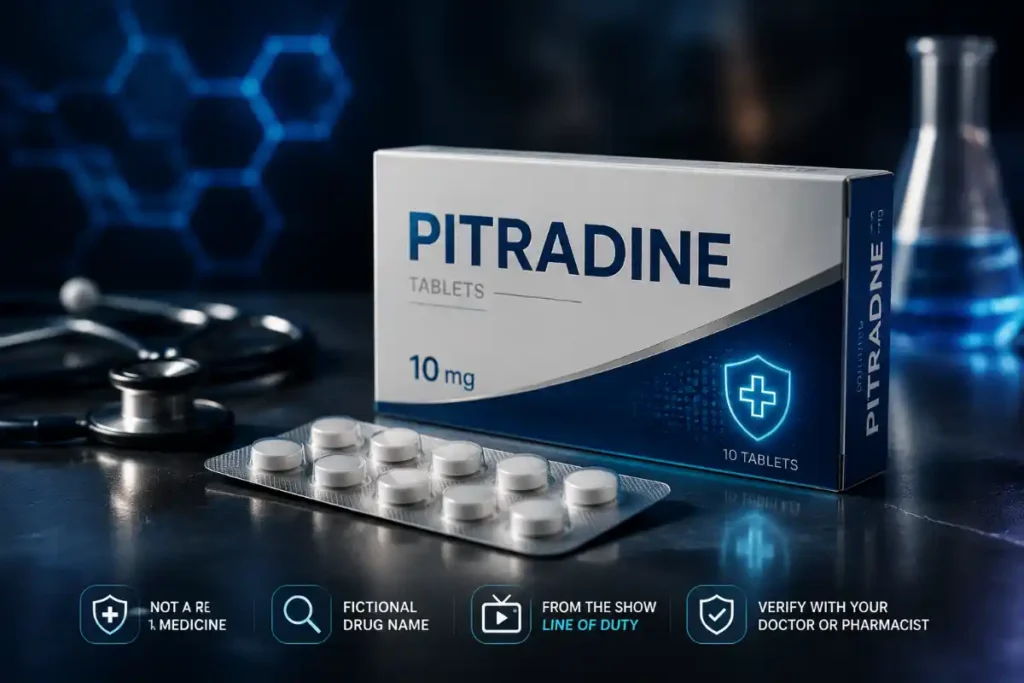
If you searched for pitradine medicine, pitradine tablet, pitradine uses, or pitradine dosage, you may be surprised by the answer: Pitradine is not an established pharmaceutical product. The name appears in connection with the BBC crime drama Line of Duty, where it was used on a fictional prescription associated with DS Steve Arnott. Contemporary coverage of the show’s Series 6 Easter-egg campaign identified Pitradine and Charzepam as made-up drug names.
That distinction is important. There is no reliable basis for treating the name as a real medicine with an established active ingredient, approved dosage, clinical indication, or genuine Pitradine price. If you encountered the name on a prescription, medicine package, social-media post, or website claiming otherwise, the safest approach is to verify the exact name with a pharmacist or doctor rather than guessing what it represents.
What Is Pitradine?
Pitradine is a fictional medicine name associated with Line of Duty, rather than a recognized drug with an established pharmaceutical profile.
The name became searchable because of an online Easter-egg trail released around the launch of Series 6. One of the documents in that trail was a prescription note for DS Steve Arnott, played by Martin Compston. The note included ibuprofen, codeine, Pitradine, and Charzepam. Coverage of the Easter egg specifically described Pitradine and Charzepam as made-up names.
This explains why searches for the formulation can be confusing. A name printed on a fictional prop can look exactly like the name of a legitimate prescription product, especially when it appears alongside real medicines.
Is Pitradine a Real Medicine?
There is no reliable evidence that the name represents an approved pharmaceutical medicine or a commercially established drug.
More importantly, the available evidence directly connects it to the fictional prescription used in Line of Duty. Contemporary reporting on the show’s Easter-egg material explicitly identified the name as made up.
Therefore, there is no verified pitradine composition, standard dosage, approved indication, or genuine adverse-effect profile that should be used for medical treatment.
Where Does the Name Pitradine Come From?
The name comes from the fictional world of Line of Duty. The series is a British crime drama centered on AC-12, an anti-corruption police unit, and DS Steve Arnott is one of its central characters. The Series 6 promotional Easter-egg trail included fictional documents that expanded the show’s story outside the episodes themselves.
The prescription note was particularly relevant because Steve Arnott’s storyline in Series 6 involved dependence on prescription medication following his earlier injuries. Contemporary coverage of the Easter eggs identified Pitradine and Charzepam as fictional additions to the prescription.
So if you first saw pitradine medicine in connection with Line of Duty, the television-show explanation is the key to understanding the name.
Why Does Pitradine Sound Like a Real Drug?
Pitradine sounds pharmaceutical, which makes the fictional prop more convincing.
Many medicine names have recognizable patterns, and drug names can contain similar-sounding endings. However, similarity in spelling or pronunciation does not establish that two medicines belong to the same chemical or therapeutic class.
This is particularly important here. The fact that the name resembles real pharmaceutical terminology does not provide evidence for its chemical composition, medical uses, or dosage.
A fictional name can be deliberately constructed to sound medically plausible without corresponding to an actual active pharmaceutical ingredient.
Read More: Pitradine
What Was Pitradine Supposed to Be in Line of Duty?
The fictional prescription was associated with Steve Arnott’s treatment for his back pain. Contemporary coverage of the Easter egg noted that the prescription contained ibuprofen, codeine, Pitradine, and Charzepam. One report described the fictional medicine as being indicated in the show’s context as codeine-based and Charzepam as a benzodiazepine-type fictional medicine.
That information should be understood as story-world information, not as a real pharmaceutical specification.
There is no legitimate reason to translate the fictional description into a real-world dosage, side-effect profile, or treatment recommendation.
In other words:
- It is a fictional name used in Line of Duty.
- It is associated with a fictional prescription for Steve Arnott.
- The prescription also included real medicines such as ibuprofen and codeine.
- Any pharmaceutical characteristics attributed to it belong to the show’s fictional context.
- They should not be treated as instructions for real-world medication use.
Pitradine Uses: Does It Have Any Medical Use?
There are no established real-world pitradine uses because the name does not identify a recognized medicine with a verified active ingredient.
The useful distinction is between its fictional role and a real therapeutic indication.
Within the Line of Duty storyline, the name appears as part of Steve Arnott’s prescription and is connected with the medication storyline surrounding his back pain.
Outside that fictional setting, there is no verified clinical indication that should be presented as a legitimate use.
This also means that websites claiming that the product treats pain, anxiety, inflammation, infection, or another condition should not automatically be trusted simply because the name sounds like a medicine.
Pitradine Composition: What Is the Active Ingredient?
There is no verified real-world pitradine composition.
A genuine medicine normally has an identifiable active ingredient, dosage strength, formulation, manufacturer or marketing authorization information, and appropriate regulatory documentation. None of those details should be invented for this fictional name.
The prescription shown in the television-related material may suggest a role for the name within the show’s narrative, but that does not establish a real chemical composition.
This is one of the most important points for anyone searching for the composition: do not substitute another medicine merely because its name sounds similar.
Pitradine Dosage: How Much Should You Take?
There is no medically established dosage for this name.
Because it is not an established medicine with a verified active ingredient, there is no legitimate dosage schedule that can safely be provided under this name.
If you have been given a prescription or package that appears to say Pitradine, do not attempt to calculate a dose from information found online. Instead:
- Check the spelling on the prescription or packaging.
- Look for the active ingredient and strength.
- Ask the dispensing pharmacist to identify the medicine.
- Contact the prescribing clinician if the name remains unclear.
- Do not substitute pethidine, phenazopyridine, or another similarly named medicine.
A one-letter difference in a drug name can represent a completely different medicine.
Pitradine Side Effects: Are There Any?
There is no verified pitradine side effects profile because there is no established real-world pharmaceutical product under this name.
This is another area where fabricated information can be dangerous. It would be inappropriate to assign side effects based on spelling, a fictional role, or another medicine with a similar name.
If a source lists a detailed adverse-effect profile without identifying a legitimate active ingredient and an authoritative pharmaceutical source, that information should be treated with caution.
Real Medicines That Sound Similar to Pitradine
Several legitimate drug names can look or sound somewhat similar. Similarity does not mean equivalence.
| Medicine | What it is | Important distinction |
| Pethidine | An opioid analgesic | It is a real medicine and is completely different from the fictional name. |
| Piritramide | A synthetic opioid analgesic used in some countries | It is a separate pharmaceutical substance with its own medical indications and risks. |
| Phenazopyridine | A urinary tract analgesic | It is unrelated to the fictional name. |
Read More: Pitradine
These names are included only to help explain why a spelling or transcription error can confuse. They should not be treated as alternatives.
Pethidine
Pethidine, also known as meperidine in some markets, is a genuine opioid analgesic. It has established medical uses and important safety considerations.
Because it is a real pharmaceutical substance, information about its indications, dosing, contraindications, and adverse effects must come from authoritative medical or prescribing sources.
It should never be assumed to be what someone meant by the unfamiliar name.
Piritramide
Piritramide is another legitimate opioid analgesic, used particularly in some European medical settings. Its name is sufficiently different that the two should not be treated as interchangeable.
Again, the similarity is useful only when considering the possibility of a spelling or transcription error.
Phenazopyridine
Phenazopyridine is a different type of medicine used for short-term relief of urinary discomfort in some countries. Its name shares some letters and sounds with the fictional term, but it is not the same substance.
A search for pitradine uses should therefore never lead directly to phenazopyridine information without confirming the actual medicine name.
Is There a Pitradine Tablet?
There is no verified basis for treating pitradine tablet as the name of a legitimate, commercially established medicine.
The word “tablet” may appear in searches because people assume that any unfamiliar pharmaceutical-sounding name refers to a pill. In this case, that assumption is misleading.
If you saw the term in a search result, social-media post, fictional document, or entertainment discussion, check the source before assuming it describes a real medication.
A genuine package should provide identifying information such as the medicine’s active ingredient, strength, manufacturer, and other labeling details appropriate to the market.
Is There a Pitradine Price?
There is no reliable standard pitradine price because there is no established real-world pharmaceutical product under that name.
Any website presenting a price for a supposed tablet should be examined carefully. A price by itself does not prove that a medicine exists.
The more useful questions are:
- What is the active ingredient?
- Who manufactures the product?
- What is its regulatory status?
- Is there legitimate packaging?
- Can a pharmacist verify the product?
- Does an authoritative medicine reference identify it?
If those details cannot be confirmed, do not purchase or consume the product based solely on the name.
What Should You Do If a Prescription Says Pitradine?
If you have encountered the name on an actual prescription, do not assume the doctor prescribed a fictional medicine.
A spelling error, handwriting problem, transcription error, brand-name confusion, or misunderstanding may explain the discrepancy.
The safest approach is to verify the medicine before taking it.
First, check the original prescription or packaging. Look carefully at every letter and check whether an active ingredient is printed underneath the brand name.
Second, ask a pharmacist. Pharmacists routinely identify medicines from prescription labels, packaging, active ingredients, and strengths.
Third, contact the prescriber if necessary. If the name cannot be confirmed, ask the prescribing clinician to clarify exactly what was intended.
Fourth, do not guess from similar names. Pethidine, piritramide, phenazopyridine, and other medicines are not substitutes for an unidentified product.
This is especially important for prescription medicines, where an incorrect substitution can create serious risks.
How to Verify an Unfamiliar Medicine Name
When a medicine name looks unfamiliar, use a verification process rather than relying on search-engine results alone.
1. Check the Exact Spelling
Compare the name with the original prescription, pharmacy label, or packaging.
2. Find the Active Ingredient
The active ingredient is generally more useful for identification than a brand name because different countries can use different brand names for the same substance.
3. Confirm the Strength
A medicine name without its strength may be insufficient for safe identification.
4. Ask a Pharmacist
A licensed pharmacist can help determine whether the name corresponds to a genuine medicine and whether the spelling or product information appears correct.
5. Use Authoritative References
For genuine medicines, consult appropriate national regulatory information, official prescribing information, or established professional drug references.
6. Do Not Trust Fictional or Social-Media Sources as Medical References
Names from television shows, films, memes, screenshots, forums, and social-media posts may be fictional, incorrectly transcribed, or presented without context.
Pitradine vs. a Real Prescription Medicine
The simplest way to understand the issue is to separate the fictional name from real pharmaceutical identification.
| Question | Pitradine |
| Is it established as a real medicine? | No reliable evidence establishes it as a real pharmaceutical product. |
| Where is the name known from? | A fictional prescription associated with Line of Duty. |
| Does it have a verified active ingredient? | No verified real-world active ingredient. |
| Is there an established dosage? | No. |
| Does it have a verified side-effect profile? | No. |
| Is there an established pharmacy price? | No reliable standard price. |
| Can another medicine be substituted for it? | No. Verify the intended medicine first. |
Why Accurate Identification Matters
Medicine-name confusion is not just an SEO problem. It can become a patient-safety problem when an unfamiliar name is treated as if it were a confirmed prescription.
Two medicines can have similar-looking names while having completely different active ingredients, indications, doses, interactions, and risks.
That is why an article about this topic should not invent the formulation, pitradine dosage, or pitradine side effects merely because users search for those terms.
The correct answer can sometimes be that the requested pharmaceutical information does not exist.
In this case, that is the most useful answer.
Conclusion
Pitradine is best understood as a fictional medicine name from Line of Duty rather than a real pharmaceutical product. It appeared on a fictional prescription associated with DS Steve Arnott during the promotional Easter-egg campaign for Series 6, alongside real medicines including ibuprofen and codeine. Contemporary coverage explicitly described Pitradine and Charzepam as made-up names.
As a result, there is no verified real-world pitradine composition, pitradine dosage, pitradine uses, pitradine side effects, or pitradine price that should be used for medical treatment.
If you encountered the name on an actual prescription or medicine package, do not assume it refers to the fictional drug from television. Check the original spelling, identify the active ingredient, and confirm the medicine with a pharmacist or prescribing clinician before taking it.
Frequently Asked Questions
Is Pitradine a real medicine?
No reliable evidence establishes Pitradine as a real pharmaceutical product. The name is associated with a fictional prescription in Line of Duty, and contemporary coverage of the show’s Easter-egg campaign identified it as a made-up drug name.
What is Pitradine used for?
There is no established real-world medical use for Pitradine. Its role exists within the fictional Line of Duty storyline rather than as a recognized therapeutic product.
Is there a Pitradine tablet?
There is no verified pharmaceutical product that can reliably be identified as a Pitradine tablet. If you encounter that name on packaging or a prescription, verify the product with a pharmacist.
What is the Pitradine composition?
There is no verified real-world active ingredient or pharmaceutical composition for Pitradine. Claims giving a specific chemical ingredient should not be treated as established medical information.
What is the correct Pitradine dosage?
There is no medically established dosage under this name. Do not take or substitute a medicine based on an unfamiliar name without confirming its exact identity.
Does Pitradine have side effects?
No verified real-world side-effect profile exists for Pitradine. A fictional medicine should not be assigned the adverse effects of another drug simply because the names sound similar.
Where did the name Pitradine come from?
The name appeared on a fictional prescription associated with DS Steve Arnott in Line of Duty during the show’s Series 6 promotional Easter-egg campaign.
What medicines can be confused with Pitradine?
Names such as pethidine, piritramide, and phenazopyridine may look or sound somewhat similar, but they are distinct real medicines and should not be treated as equivalents.
Can I buy Pitradine online?
There is no reliable basis for treating Pitradine as an established pharmaceutical product available for legitimate purchase. Be cautious of websites offering a product under this name without verifiable pharmaceutical identification.
What should I do if my prescription says Pitradine?
Do not guess. Check the original prescription or packaging and ask a pharmacist or the prescribing clinician to confirm the exact medicine, active ingredient, and strength before taking it.




1 thought on “Pitradine: The Complete Truth About a Fake Medicine Name”