
Ultimate Caftan Guide: Beautiful Styles & Costly Mistakes to Avoid
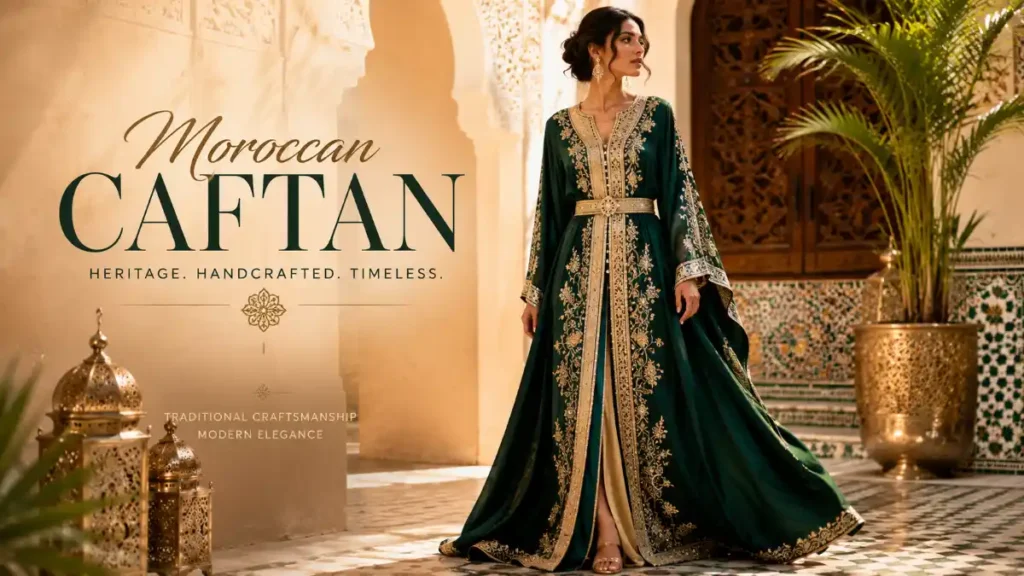
A caftan can be a lightweight beach layer, an elegant evening dress, or a richly decorated Moroccan garment associated with weddings and celebrations. The difficulty is that retailers often use the same word for very different garments. Understanding the differences in construction, fabric, regional traditions, fit, and craftsmanship makes it much easier to choose the right piece.
This guide focuses on the buyer’s perspective. It explains Moroccan caftan traditions, compares them with related garments such as djellabas, abayas, and boubous, and shows what to check before buying a caftan dress online or in person. It also covers caftan styles, fabrics, sizing, care, and the difference between traditional artisan work and contemporary interpretations.
What Is a Caftan?
A caftan is broadly a long, robe-like or tunic-style garment whose form varies considerably between cultures and periods. The term does not describe one universal cut or fabric.
The Moroccan tradition has its own distinctive characteristics. UNESCO describes the Moroccan caftan as a long tunic worn by people of different genders and ages for special occasions and celebrations. It can be made in different fabrics and styles and may be worn with or without a decorative belt. Traditional examples can feature a central opening, buttons, embroidery, beads, sequins, and other handmade decoration.
That distinction is important when shopping. A loose resort cover-up sold as a caftan and a highly embellished Moroccan ceremonial garment may share a name, but they serve very different purposes.
Moroccan Caftan: What Makes It Distinct?
The Moroccan version is especially associated with tailoring and decorative craftsmanship. Depending on the design, details can include sfifa, decorative braided trim, aakad or traditional button-and-loop fastenings, embroidery, beading, sequins, and a decorative belt.
UNESCO’s 2025 inscription is particularly significant because it recognizes not simply a garment, but the art, traditions, skills, and craftsmanship associated with the Moroccan caftan as intangible cultural heritage. The inscription notes that production involves multiple skilled craftspeople, including weavers, tailors, and artisans responsible for buttons, braids, and embroidery.
The recognition does not mean every garment marketed as a Moroccan caftan is handmade or historically traditional. It recognizes the living cultural practice and knowledge behind the tradition. That distinction is useful for shoppers evaluating authenticity claims.
A Note on History
The history of the Moroccan caftan is more complicated than a single origin date suggests. Sources describe different stages in its development and different influences on Moroccan dress. Some accounts connect the garment to medieval Moroccan court culture, while other historical discussions emphasize Ottoman and wider Mediterranean influences and point to clearer documentary evidence from later periods.
For buyers, the safest conclusion is that the Moroccan caftan has developed over centuries rather than emerging as one unchanged garment at one precise moment. Claims that confidently assign a single invention date should therefore be treated cautiously.
Regional Moroccan Caftan Styles
Morocco does not have one completely uniform caftan tradition. Regional tailoring and embroidery practices have produced recognizable differences, although modern fashion has blurred some of those boundaries.
| Region | Common characteristics |
| Fez | Strong association with refined tailoring, rich embroidery, and formal fabrics |
| Rabat/Salé | Rabat traditions are associated with distinctive embroidery and decorative finishing |
| Tetouan | Northern traditions show strong Andalusian cultural influences and distinctive embroidery.y |
| Marrakech | Contemporary interpretations often emphasize fluid silhouettes, color, and movement. nt |
Read More: Caftan
These descriptions should be treated as broad stylistic tendencies rather than rigid rules. A modern designer may combine techniques, fabrics, or silhouettes associated with several regions.
If heritage and provenance matter to you, ask the seller where the garment was made, who made it, what techniques were used, and whether the regional description refers to actual craftsmanship or simply to the product’s marketing style.
Caftan vs. Djellaba, Abaya, and Boubou
Long, loose garments can look similar in photographs, but their cultural origins and typical construction differ.
Caftan vs. Djellaba
A Moroccan djellaba is traditionally a long robe characterized by its hood and practical, loose construction. It is strongly associated with everyday Moroccan dress, although versions can also be made for special occasions.
A formal Moroccan caftan, by contrast, is more closely associated with decorative tailoring and ceremonial dressing. The two garments can overlap in modern fashion, but they should not automatically be treated as interchangeable.
Caftan vs. Abaya
An abaya is a cloak-like outer garment associated particularly with Arab societies, including the Gulf, although contemporary abayas exist in many colors, fabrics, cuts, and levels of decoration.
A Moroccan caftan belongs to a different regional clothing tradition. Modern fashion can borrow silhouettes across cultures, but the names do not describe the same historical garment.
Caftan vs. Boubou
The boubou, or grand boubou, belongs to West African clothing traditions and is known for its flowing, generous silhouette. It can be made from richly patterned, embroidered, or woven textiles.
Its loose shape may resemble some caftan outfits, but the cultural and textile traditions behind the garments are different.
For shoppers, this distinction matters because a product labeled simply as a “caftan” may actually be a contemporary interpretation inspired by several regional robe traditions.
How to Choose the Right Caftan for Your Occasion
The best choice depends more on intended use than on appearance alone.
For Everyday Wear
Choose a lightweight garment with minimal embellishment and an easy-care fabric. Cotton, linen, and some rayon or viscose constructions can work well for casual wardrobes, depending on the weave and care instructions.
A shorter or midi-length silhouette may also be easier to wear regularly than a heavily decorated floor-length design.
For the Beach or Resort
A beach caftan should be easy to layer over swimwear and comfortable in warm conditions. Look for lightweight cotton, voile, gauze, crochet, or other breathable constructions.
An open-front design is particularly convenient because it can be slipped on and removed easily. Check whether the fabric is transparent before purchasing if you intend to wear it outside the beach or pool area.
For Weddings and Formal Events
This is where highly embellished Moroccan-inspired designs can make the greatest visual impact. Look for structured tailoring, decorative trim, embroidery, beading, silk or silk-blend fabrics, velvet, brocade, or other formal textiles depending on the season.
If cultural authenticity matters, go beyond the appearance. Ask about the garment’s origin, construction, embroidery technique, and the craftspeople involved.
For Travel
Travel-friendly caftan outfits should balance appearance with practicality. Lightweight fabrics, manageable embellishment, and uncomplicated care instructions are usually more useful than a very delicate garment that requires specialist cleaning.
If you are packing internationally, also consider how much space the garment takes up and whether its embellishment can be safely folded.
Read More: Caftan
Understanding Caftan Fabrics
Fabric affects comfort, drape, appearance, durability, and care requirements.
Cotton: A practical choice for casual and warm-weather pieces. It can be breathable, depending on the weave, but may wrinkle.
Linen: Lightweight and breathable, with a naturally relaxed appearance. It can crease easily, which may or may not suit the intended look.
Silk: Known for its fluid drape and luxurious appearance. It requires more careful handling than many everyday fabrics.
Velvet: Rich and visually substantial, making it suitable for cooler-weather or formal garments. Its pile can be sensitive to pressure and incorrect storage.
Brocade: Often chosen for formal and traditional-looking garments because of its structured appearance and decorative woven patterns.
Synthetic blends: Polyester and other synthetic fibers can make garments more affordable and sometimes easier to care for. However, fiber content can substantially affect breathability, drape, and feel.
Do not judge fabric quality from a product photograph alone. Always check the fiber composition and care label when that information is available.
Hand Embroidery vs. Machine Embroidery
Embroidery can be one of the biggest differences between an artisan garment and a mass-produced interpretation, but photographs do not always make the distinction obvious.
Handwork may show subtle variations in stitch spacing, tension, or pattern execution. Machine embroidery is often more uniform because the same programmed pattern can be reproduced repeatedly.
However, irregularity alone does not prove that something is handmade, and uniformity alone does not prove that it is machine-made. A reliable seller should be able to explain how the decoration was produced.
When shopping for an expensive embroidered garment, ask:
- Is the embroidery handmade, machine-made, or a combination?
- Who performed the embroidery?
- Where was the garment made?
- What fabric is used?
- Are the buttons and trims handmade?
- Is the listed regional style based on the garment’s actual construction?
- What care method does the maker recommend?
Clear answers are more useful than vague claims such as “authentic,” “luxury,” or “traditional.”
Read More: Caftan
How to Check a Product Listing Before Buying
Online shopping creates a particular problem: the garment can look impressive in a carefully lit photograph while important construction details remain hidden.
Start with the fiber content. A listing that clearly identifies silk, cotton, linen, polyester, or a blend gives you more useful information than one that simply says “premium fabric.”
Next, examine close-up photographs. Look at seams, hems, embroidery, fastenings, and decorative trim. Full-body images show the overall silhouette, but close-ups reveal much more about finishing.
Also check the measurements. Don’t rely exclusively on S, M, L, XL, or one-size labels. Shoulder width, bust, sleeve length, garment length, and sometimes hip measurements can be more useful.
Finally, investigate the seller’s description. A transparent listing should distinguish between a garment inspired by Moroccan design and one made according to a particular Moroccan craft tradition.
How Caftan Styles Affect Fit
Not all caftans are intended to fit the body in the same way.
Some formal Moroccan designs are relatively structured through the shoulders and upper body before creating a longer, flowing silhouette. Other robe-style garments are deliberately loose throughout.
This means sizing up is not automatically the best way to create a relaxed look. On a structured design, excessive width around the shoulders can make the garment appear bulky rather than elegantly draped.
Before ordering, compare the seller’s measurements with a garment you already own that fits well. Pay particular attention to shoulder width and bust measurement if the design has structured tailoring.
A decorative belt can also dramatically change the silhouette. UNESCO notes that Moroccan caftans may be worn with or without a decorative belt, so whether a belt is essential depends on the specific design rather than one universal rule.
Caring for a Caftan
Care should always follow the manufacturer’s label because fiber, dye, embroidery, lining, and embellishment can change the appropriate cleaning method.
For delicate embroidered garments, avoid assuming that machine washing is safe simply because the base fabric appears durable. Loose trims, beads, metallic decoration, and handmade embroidery can require more careful treatment.
Silk and velvet may also need specialized care. Store delicate formal garments in a way that avoids crushing embroidery or flattening velvet pile, and keep them away from excessive moisture and direct sunlight.
For travel pieces made from washable fabrics, follow the care label rather than relying on assumptions based solely on the garment’s appearance.
Read More: Caftan
Traditional vs. Contemporary Caftan Designs
A traditional artisan garment and a modern fashion interpretation can both be good purchases; they simply serve different purposes.
A heritage-focused piece may appeal to someone who values craftsmanship, regional techniques, cultural significance, and detailed handwork. Such garments can require a larger budget and more careful maintenance.
A contemporary design may use a simplified silhouette, machine decoration, synthetic fabric, or modern construction. That can make it more accessible for everyday wear, travel, or resort styling.
The important point is transparency. A modern garment inspired by Moroccan fashion does not need to pretend to be an antique or entirely handmade traditional piece to be attractive or valuable.
A Simple Buyer’s Checklist
Before purchasing, work through these questions:
- What will I use the garment for?
- Is the fabric suitable for the climate and occasion?
- What is the exact fiber composition?
- What are the garment measurements?
- Is the embroidery handmade, machine-made, or mixed?
- Where was the garment produced?
- Does the seller identify a specific regional tradition?
- Are close-up photographs available?
- What are the washing and storage requirements?
- Is the price justified by the construction and materials rather than marketing language alone?
This approach is more reliable than choosing based only on color, reviews, or a photograph.
Frequently Asked Questions
What is a caftan?
A caftan is a long robe-like or tunic-style garment found in different cultural traditions. Moroccan examples are particularly associated with tailored construction, decorative fastenings, embroidery, and formal occasions.
Is every caftan Moroccan?
No. The word describes related garment traditions across different regions and cultures. A product sold as a caftan may be Moroccan, inspired by Moroccan fashion, or based on another robe tradition entirely.
What is a Moroccan caftan used for?
Traditional Moroccan caftans are associated with special occasions and celebrations, including weddings and other important social events. Contemporary versions can also be designed for everyday, evening, or resort wear.
What are the most common caftan styles?
Common styles vary by region and designer. Moroccan traditions include recognizable regional approaches associated with places such as Fez, Rabat/Salé, and Tetouan, while contemporary designers may combine traditional details with modern silhouettes.
What is the difference between a caftan and a djellaba?
A djellaba is traditionally a hooded Moroccan robe associated strongly with practical everyday wear. A formal Moroccan caftan is generally more decorative and closely associated with ceremonial dressing, although modern fashion can blur the distinction.
Is a caftan good for the beach?
Yes. A lightweight beach caftan can work well as a cover-up over swimwear. Breathable, easy-to-layer fabrics and simple construction are usually more practical than heavy embroidery or structured formal materials.
How do I know if caftan embroidery is handmade?
Ask the seller directly and inspect close-up photographs. Handwork can show subtle variation, but visual appearance alone is not conclusive. A transparent description of the technique and maker provides stronger evidence.
Should I size up when buying a caftan?
Not automatically. Loose designs may already provide substantial room, while structured formal designs can require closer attention to shoulder and bust measurements. Compare the garment’s measurements with something you already own.
Which fabric is best for a caftan?
There is no single best fabric. Cotton and linen can suit casual or warm-weather wear, while silk, velvet, and brocade can work well for more formal designs. The right choice depends on occasion, climate, comfort, and care requirements.
What should I check before buying a caftan online?
Check fiber content, measurements, construction photographs, embroidery details, seller information, country or region of production, return conditions, and care instructions. For expensive traditional pieces, ask specific questions about craftsmanship and provenance before purchasing.


1 thought on “Ultimate Caftan Guide: Beautiful Styles & Costly Mistakes to Avoid”