
Hair Types: Complete 1A–4C Chart, Identification Guide & Care Tips
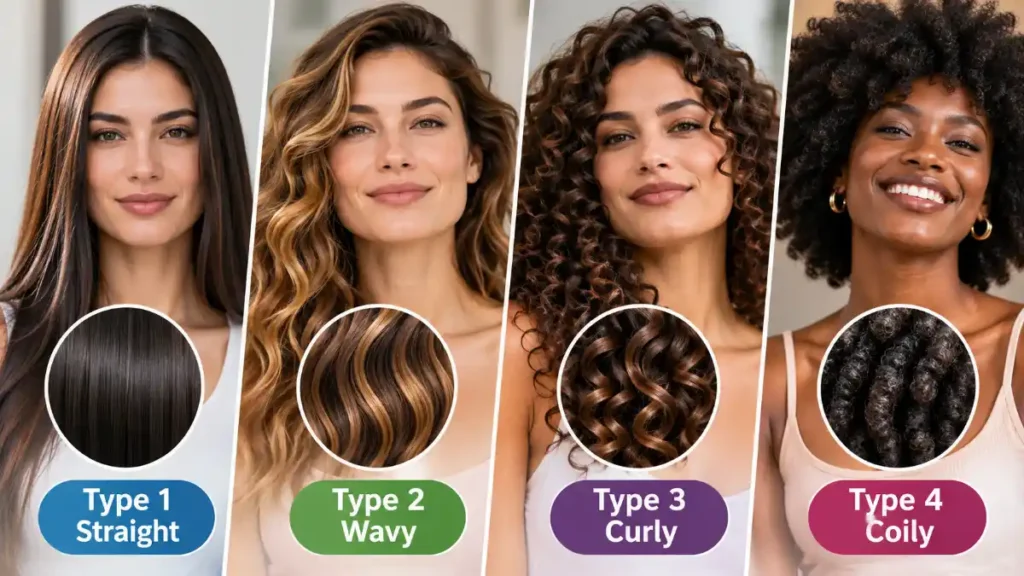
Human hair is commonly divided into four main hair types: straight (Type 1), wavy (Type 2), curly (Type 3), and coily (Type 4). The popular 1A–4C classification system breaks these categories into 12 subtypes based on natural wave, curl, and coil patterns. Knowing your hair type can help you understand how your hair behaves and choose cleansing, conditioning, and styling methods that suit its needs.
The easiest way to identify your hair type is to examine it after washing and letting it air-dry without heat or styling products. Compare your natural pattern with the hair types chart below to find your closest match. Keep in mind that curl pattern is just one factor in hair care. Strand thickness, density, porosity, and scalp condition also affect which products and routines work for you.
Hair Types Chart: All 12 Types From 1A to 4C
The chart below compares all 12 commonly recognized hair subtypes, from completely straight strands to tightly coiled patterns. Within each numbered category, the letters A, B, and C generally indicate increasingly pronounced waves, curls, or coils. These distinctions are approximate rather than scientifically fixed.
| Hair Type | Natural Pattern | Common Characteristics | Care Priorities |
| 1A | Completely straight | Little visible bend; often lies flat | Lightweight conditioning, volume |
| 1B | Straight with body | Some natural fullness | Preventing buildup |
| 1C | Mostly straight with slight bends | May appear fuller or frizzier | Smoothing, gentle styling |
| 2A | Loose S-shaped waves | Subtle waves, often near the ends | Lightweight wave definition |
| 2B | Defined S-waves | More noticeable waves and frizz | Frizz control, conditioning |
| 2C | Strong S-waves | Pronounced waves, sometimes loose curls | Moisture, curl-friendly styling |
| 3A | Large spiral curls | Loose, defined ringlets | Conditioning, curl definition |
| 3B | Springy ringlets | Smaller, tighter spirals | Detangling, moisture |
| 3C | Tight corkscrew curls | Compact, closely spaced curls | Gentle handling, conditioning |
| 4A | Small, defined coils | Tight coils with noticeable shrinkage | Moisture retention |
| 4B | Tight bends and coils | Less uniform, sometimes angular patterns | Careful detangling |
| 4C | Very compact coils | Significant shrinkage; definition varies | Reducing breakage, gentle styling |
This system provides a convenient way to describe curl patterns, but it isn’t a medical diagnosis or a definitive scientific classification. The commonly used 4C category was added after the original André Walker system was developed.
A 2026 systematic review of hair classification methods also highlights the system’s limitations, including its inability to account fully for differences in hair density, porosity, and mixed curl patterns. Subtype boundaries aren’t always clear, and your hair doesn’t have to fit perfectly into one category.
The Four Main Hair Types Explained
Type 1: Straight Hair (1A, 1B, 1C)
Type 1 hair doesn’t form a consistent wave or curl pattern. 1A is typically very straight, 1B has more natural body, and 1C may show slight bends along the strands.
Scalp oils can travel along straight hair relatively easily, but that doesn’t mean everyone with straight hair has an oily scalp. Lightweight conditioners and cleansing products suited to your scalp can help keep hair soft without weighing it down or leaving excess buildup.
Type 2: Wavy Hair (2A, 2B, 2C)
Type 2 hair forms S-shaped waves rather than complete spiral curls. 2A has loose, subtle waves, 2B shows more noticeable definition, and 2C features stronger waves that may resemble loose curls.
Heavy styling products can sometimes flatten these waves or make them look less defined. A lightweight leave-in conditioner, mousse, or gel may help manage frizz while allowing the hair to retain its natural movement.
Type 3: Curly Hair (3A, 3B, 3C)
Type 3 hair forms recognizable spirals and ringlets. 3A curls tend to be broad and loose, 3B curls are smaller and springier, and 3C forms tighter corkscrew patterns.
Curly hair can be more susceptible to dryness and tangling, particularly when handled roughly or exposed to excessive heat. Regular conditioning, gentle detangling, and suitable styling products can make curls easier to manage while reducing unnecessary breakage.
Type 4: Coily Hair (4A, 4B, 4C)
Type 4 hair forms tight coils, compact curls, or sharply curved bends. 4A often has small, defined coils, 4B may show tighter, more angular patterns, and 4C typically features very compact coils with varying degrees of visible definition.
Coily hair can shrink considerably as it dries, making it appear much shorter than its stretched length. It also benefits from careful handling, conditioning, and styling methods that minimize pulling.
The American Academy of Dermatology’s curly hair care guidance emphasizes moisture management and gentle detangling to help reduce dryness and breakage.
Curl tightness doesn’t determine strand thickness or hair health. Coily hair can have fine strands, straight hair can be coarse, and every category includes a wide range of natural characteristics.
How to Identify Your Hair Type
You can get a useful idea of your natural hair type by observing how your hair behaves without products or styling techniques that change its shape.
- Wash your hair. Use a suitable shampoo to remove buildup, then condition and rinse thoroughly.
- Let it air-dry. Skip heat styling, leave-in stylers, and brushing that stretches or straightens your natural pattern.
- Look at the shape. Notice whether your strands remain straight, form S-shaped waves, develop spirals, or create compact coils.
- Check different areas. Compare hair from your crown, sides, and neckline with the 1A–4C chart.
- Find your closest match. Start with the main category, then identify an approximate subtype if the pattern is clear.
It’s common to have more than one natural curl pattern. For example, you might notice 2C waves around your crown and 3A curls near your neckline. You don’t need to force every section into the same category.
The 1A–4C hair type identification guide also recommends observing clean, naturally dried hair and comparing patterns across different areas of the scalp.
Chemical straightening, repeated heat exposure, and hair damage can make your original pattern harder to recognize. If your lengths have been chemically treated, untreated new growth may offer a better indication of your natural texture, although identifying an exact subtype can still be difficult.
Hair Type vs. Thickness, Density, and Porosity
Your curl pattern tells you about the shape of your hair, but it doesn’t describe every characteristic that affects its appearance or care needs.
- Strand thickness: The diameter of an individual hair strand, generally described as fine, medium, or coarse.
- Hair density: The number of strands growing within a particular scalp area. Hair can have lower or higher density regardless of curl pattern.
- Hair porosity: How readily the hair fiber absorbs and releases water, influenced by its structure and condition.
- Scalp condition: Whether your scalp tends to be oily, dry, sensitive, or prone to flaking.
Two people with 3B curls, for example, may need different conditioners. Someone with fine, lower-density hair might prefer lighter formulas, while someone with coarse, higher-density hair may benefit from richer conditioning products.
Porosity can also influence product selection, but the popular water-glass float test isn’t a scientifically reliable standalone measurement. Drying time, product buildup, and how your hair responds to conditioner are affected by several factors, so none can accurately establish porosity on its own.
Hair Care Routine for Each Hair Type
Your natural curl pattern is a useful starting point, but scalp condition, strand characteristics, and styling preferences should shape your daily routine.
| Hair Type | Cleansing and Conditioning | Suitable Styling Approach |
| Straight | Cleanse according to scalp oiliness; use lightweight conditioner | Light styling products, minimal buildup |
| Wavy | Condition without excessive product weight | Mousse, light gel, gentle scrunching |
| Curly | Prioritize conditioning and gentle detangling | Leave-in conditioner when needed, curl cream or gel |
| Coily | Use moisturizing conditioners and detangle carefully | Gentle styling, moisture retention, low-tension hairstyles |
There’s no single washing schedule that works for everyone in a particular hair category. How often you shampoo should depend on scalp oiliness, physical activity, product buildup, and your hair’s condition. The dermatologist-recommended healthy hair care tips explain how to adjust washing, conditioning, and detangling habits to different hair needs.
For curly and coily hair, applying conditioner before gently detangling with your fingers, a wide-tooth comb, or an appropriate brush can help reduce pulling. Excessive heat and repeated tension from tight hairstyles can also contribute to breakage. The hair styling damage-prevention recommendations explain why limiting these practices matters.
Product selection shouldn’t depend on curl type alone. Rich creams may weigh down fine strands, while some coarse or damaged hair responds better to heavier conditioning formulas. Pay attention to how your hair feels and behaves, then adjust your products accordingly.
Can Your Hair Type Change Over Time?
Your visible hair pattern can change as you age or experience hormonal changes, chemical treatments, or heat damage. Genetics and hair follicle characteristics play important roles in natural curl formation, but a change in appearance doesn’t necessarily mean your underlying hair type has permanently changed.
Temporary styling can stretch or reshape curls, while chemical processing and significant heat damage may cause longer-lasting changes to treated strands. Age-related changes can also affect hair texture, thickness, and manageability.
If your hair suddenly changes texture alongside noticeable shedding, scalp irritation, or hair loss, it’s worth seeing a dermatologist rather than assuming the change is simply part of your natural hair type.
Read also: Hair Types
Frequently Asked Questions
Is frizzy hair a separate hair type?
No. Frizz isn’t a separate hair type, and it can affect straight, wavy, curly, or coily hair. It occurs when strands don’t lie smoothly together and may become more noticeable with humidity, dryness, damage, or certain styling habits. Your natural curl pattern determines your general hair category, not how much frizz you experience.
Can hair products permanently change your natural hair type?
Ordinary shampoos, conditioners, curl creams, and styling gels cannot permanently change the curl pattern produced by your hair follicles. They may temporarily smooth, define, or stretch your hair. Chemical treatments can alter the structure of existing strands more substantially, but new hair growth may retain your natural pattern.




1 thought on “Hair Types: Complete 1A–4C Chart, Identification Guide & Care Tips”