
CeraVe Sunscreen: Which Formula Is Best for Your Skin?
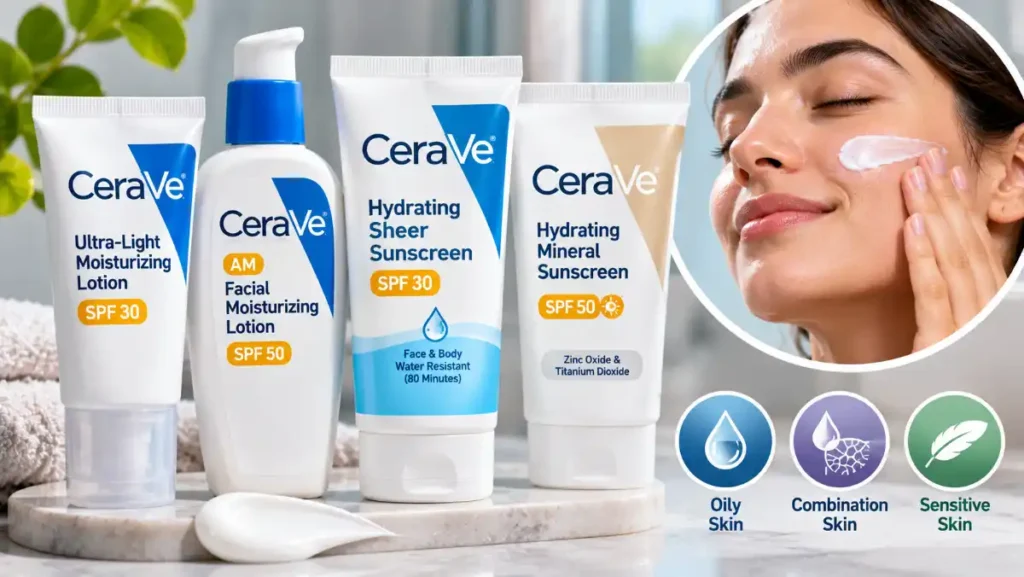
CeraVe sunscreen comes in several formulations, including mineral sunscreens, hybrid formulas, and lightweight moisturizers with SPF. The best choice depends on your skin type, preferred finish, complexion, and daily activities. CeraVe Ultra-Light Moisturizing Lotion SPF 30 is a good option for oily skin, AM Facial Moisturizing Lotion provides additional hydration, and Hydrating Sheer SPF 30 offers water-resistant protection for the face and body.
CeraVe also makes mineral SPF 50 sunscreens and tinted SPF 30 formulas for people who prefer mineral UV filters. However, these products can feel and look quite different on the skin. Comparing their textures, ingredients, customer feedback, and prices can help you find a sunscreen you’ll be comfortable wearing every day.
CeraVe Sunscreen Comparison: Products, SPF, and Prices
The main options in the CeraVe sunscreen collection include standalone sunscreens and facial moisturizers with sun protection. Their biggest differences are the UV filters they contain, their moisturizing properties, and how they feel after application.
| CeraVe sunscreen | Type / SPF | Best suited for and finish | Water resistance | Approx. US price/size |
| Invisible Mineral Sunscreen | Mineral SPF 50 | Sensitive or acne-prone skin; lightweight, blendable finish | Not established | $13.99 / 1.62 fl oz |
| Hydrating Mineral Face Lotion | Mineral SPF 50 | Normal, dry, or sensitive skin; moisturizing but may leave a white cast | Not labeled water-resistant | $13.99 / 2.5 fl oz |
| Hydrating Mineral Face Sheer Tint | Mineral SPF 30 | Tinted facial protection; sheer, radiant finish | Not established | $13.99 / 1.7 fl oz |
| Hydrating Sheer Face & Body | Hybrid SPF 30 | Lightweight, non-greasy protection for face and body | 80 minutes | $13.99 / 3 fl oz |
| AM Facial Moisturizing Lotion SPF 30 | Hybrid SPF 30 | Normal to dry skin; hydrating daily lotion | Not labeled water-resistant | $14.99 / 3 fl oz |
| AM Facial Moisturizing Lotion SPF 50 | Hybrid SPF 50 | Normal to dry skin; higher-SPF moisturizing option | Not established | $14.19 / 3 fl oz |
| Ultra-Light Moisturizing Lotion | Chemical-filter SPF 30 | Normal to oily skin; lightweight matte finish | Not labeled water-resistant | $14.19 / 1.7 fl oz |
Prices are approximate US retail figures checked November 2, 2026, and may change with location, retailer, and promotions. “Not established” means a water-resistance duration wasn’t verified, so it shouldn’t be assumed.
All these products provide broad-spectrum UVA and UVB protection. Hydrating Sheer SPF 30 has a confirmed 80-minute water-resistance claim, making it more suitable for swimming or sweating than formulas without verified water resistance.
Which CeraVe Sunscreen Is Best for Your Skin Type?
Oily, Combination, and Acne-Prone Skin
If you have oily skin, CeraVe Ultra-Light Moisturizing Lotion SPF 30 is a sensible starting point. Its lightweight texture and matte finish can help reduce shine without leaving your face feeling heavily moisturized.
Hydrating Sheer SPF 30 is another option if you prefer a fluid consistency. If you specifically want mineral protection, consider Invisible Mineral SPF 50, which is formulated to blend more transparently than traditional untinted mineral lotions.
Many CeraVe sunscreens are labeled non-comedogenic, meaning they’re formulated not to clog pores. That doesn’t guarantee they’ll work for everyone, though. Some people may still experience breakouts, stinging, or irritation, so it’s worth testing a new formula on a small area first.
Dry, Sensitive, and Mature Skin
CeraVe AM Facial Moisturizing Lotion SPF 30 and SPF 50 combine hydration with sun protection, making them convenient for normal-to-dry skin. Hydrating Mineral SPF 50 Face Lotion is another option if you prefer mineral UV filters.
For mature skin, a comfortable moisturizing formula may be particularly appealing. It can help prevent dryness from making fine lines look more noticeable, although the finish depends on the individual product and how much you apply.
If your skin is sensitive, a fragrance-free mineral sunscreen may be worth trying. However, fragrance-free doesn’t automatically mean irritation-free. Even mineral formulas can cause reactions, especially when your skin barrier is already irritated.
Medium and Deep Skin Tones: White Cast and Tinted Options
White cast is one of the biggest concerns when choosing CeraVe mineral sunscreen SPF 50.
Traditional untinted mineral sunscreens containing zinc oxide and titanium dioxide can leave a pale residue, especially on medium and deep complexions. The amount you apply and how well the formula blends also affect how noticeable it looks.
CeraVe offers two alternatives:
- Hydrating Mineral SPF 30 Face Sheer Tint: Available in Light, Medium, and Deep shades, with tint designed to reduce the chalky appearance associated with some mineral sunscreens.
- Invisible Mineral Sunscreen SPF 50: Marketed as a lightweight mineral formula with a blendable, no-white-cast finish.
Customer feedback suggests the difference can be substantial. Reviews of Hydrating Mineral SPF 50 Face Lotion often mention visible whitening and difficulty blending, although some users appreciate its moisturizing texture. Invisible Mineral SPF 50 generally receives better feedback for its finish, but individual results still vary. Its product description and formulation details provide further information about its intended performance.
Neither option is guaranteed to disappear completely on every complexion. Your undertone, the amount applied, and the formula’s tint all influence the final appearance.
If white cast is your main concern, it may also help to compare products specifically developed with deeper complexions in mind, such as those covered in this guide to Black Girl Sunscreen.
CeraVe’s tinted sunscreen can be worn beneath makeup. Letting it settle before applying foundation may help prevent uneven layering, although pilling and greasiness can depend on the other skincare products you’re using. For lighter coverage, you can also compare the finishes and uses of different tinted moisturizers.
CeraVe Sunscreen Ingredients: Mineral vs. Chemical Filters
CeraVe uses different UV filters across its sunscreen range, so not every product protects your skin through the same combination of ingredients.
Mineral sunscreens contain zinc oxide, titanium dioxide, or both. Hydrating Mineral SPF 50 Face Lotion, for example, contains 7% zinc oxide and 9% titanium dioxide. These filters primarily absorb UV radiation while also reflecting and scattering some of it.
Chemical sunscreens rely on organic UV filters that absorb ultraviolet radiation. CeraVe Ultra-Light Moisturizing Lotion SPF 30 contains avobenzone, homosalate, octisalate, and octocrylene.
Hybrid formulas combine mineral and chemical filters. CeraVe Hydrating Sheer SPF 30 uses zinc oxide alongside homosalate, octisalate, and octocrylene. This combination is intended to provide broad-spectrum protection in a lighter-feeling formula.
Beyond their UV filters, individual CeraVe sunscreens may contain ingredients that support hydration and skin comfort:
- Ceramides NP, AP, and EOP: Help maintain the skin’s protective moisture barrier.
- Hyaluronic acid and glycerin: Help attract and retain moisture.
- Niacinamide: Supports skin barrier function and may help calm irritated-looking skin.
- Panthenol: Helps condition the skin and support moisture retention.
These ingredients aren’t present in identical amounts across every product. If you’re sensitive to a particular ingredient, always check the formula you’re purchasing rather than assuming all CeraVe sunscreens are the same.
People who prefer mineral UV filters can also explore alternatives such as those discussed in this Blue Lizard sunscreen guide, particularly when comparing finishes and white-cast concerns.
SPF 30 vs. SPF 50: Does the Difference Matter?
SPF measures protection against sunburn-causing UV radiation under standardized testing conditions. SPF 30 filters approximately 97% of UVB radiation, while SPF 50 filters about 98%.
That difference may seem small, but SPF 50 provides somewhat greater protection when applied correctly. It doesn’t, however, last longer or remove the need to reapply.
Broad-spectrum labeling matters just as much as the SPF number because it indicates protection against both UVA and UVB radiation.
How to Apply CeraVe Sunscreen Correctly
Apply sunscreen generously to exposed skin, including your face, ears, and neck. The American Academy of Dermatology’s sunscreen application guidance recommends at least one teaspoon for the face, although the amount needed can vary with the area you’re covering.
If you’re using a separate sunscreen, apply it after your moisturizer and before makeup. CeraVe AM Facial Moisturizing Lotion with SPF can serve as both your moisturizer and sunscreen, provided you use enough to achieve its labeled protection.
This distinction matters because applying only a thin layer of SPF moisturizer may leave your skin less protected than the product’s SPF rating suggests.
For effective protection:
- Follow the product’s directions, generally applying sunscreen about 15 minutes before going outdoors.
- Reapply approximately every two hours while spending time outside.
- Reapply after swimming, sweating, or towel drying according to the individual product’s instructions.
- Use shade, protective clothing, and a wide-brimmed hat for additional protection.
CeraVe Hydrating Sheer SPF 30 is water-resistant for up to 80 minutes. Its directions call for reapplication after 80 minutes of swimming or sweating and immediately after towel drying.
The FDA’s sunscreen safety guidance also makes clear that no sunscreen is waterproof. Even with a high SPF, one morning application isn’t enough for an entire day of outdoor exposure.
Is CeraVe Sunscreen Worth Buying?
CeraVe sunscreen is worth considering if you want broad-spectrum sun protection combined with moisturizing ingredients and a choice of textures. The range includes options for oily, dry, and sensitive skin, but selecting the wrong finish or tint can make a product less pleasant to wear.
Price matters too, especially if you use sunscreen daily. Comparing the cost per fluid ounce gives you a clearer picture of value than looking at the package price alone.
| Product | Approx. cost per fl oz |
| Hydrating Sheer SPF 30 Face & Body | $4.66 |
| AM Facial Moisturizing Lotion SPF 50 | $4.73 |
| AM Facial Moisturizing Lotion SPF 30 | $5.00 |
| Hydrating Mineral SPF 50 Face Lotion | $5.60 |
| Hydrating Mineral SPF 30 Sheer Tint | $8.23 |
| Ultra-Light Moisturizing Lotion SPF 30 | $8.35 |
| Invisible Mineral SPF 50 | $8.64 |
Calculations use the approximate US prices and sizes listed above, checked November 2, 2026. Actual costs may differ depending on current retailer pricing and promotions.
Hydrating Sheer SPF 30 has one of the lowest costs per ounce among these products, along with verified water resistance. Still, the least expensive formula isn’t necessarily the best value if you dislike how it feels or it doesn’t suit your skin.
For oily skin, Ultra-Light SPF 30 remains a practical choice. AM Facial Moisturizing Lotion is convenient for dry skin, while Hydrating Mineral SPF 50, Invisible Mineral SPF 50, and the tinted SPF 30 formulas offer different approaches to mineral protection. If you’re swimming or sweating, Hydrating Sheer SPF 30 has the advantage of a clearly stated water-resistance duration.
Ultimately, the best CeraVe sunscreen is one that provides appropriate protection, works comfortably with your skin, fits your budget, and is easy enough to use consistently.
Frequently Asked Questions
Can CeraVe sunscreen cause eye irritation?
Yes. Some people experience eye stinging or watering when sunscreen migrates into the eyes, even with fragrance-free formulas. Individual sensitivity varies, and no CeraVe sunscreen can be guaranteed not to sting. Avoid direct eye contact, follow the product’s application directions, and stop using a formula if it repeatedly irritates.
Does CeraVe sunscreen expire?
Yes. Like other sunscreens, CeraVe products have a limited shelf life. Check the packaging for an expiration date and replace the product once that date has passed. If no expiration date appears, US sunscreen labeling rules generally require the product to remain stable for at least three years. Excessive heat or changes in smell, color, or texture are also reasons to replace it.




1 thought on “CeraVe Sunscreen: Which Formula Is Best for Your Skin?”