BID Medical Abbreviation: Meaning, Dosage Timing, and Examples
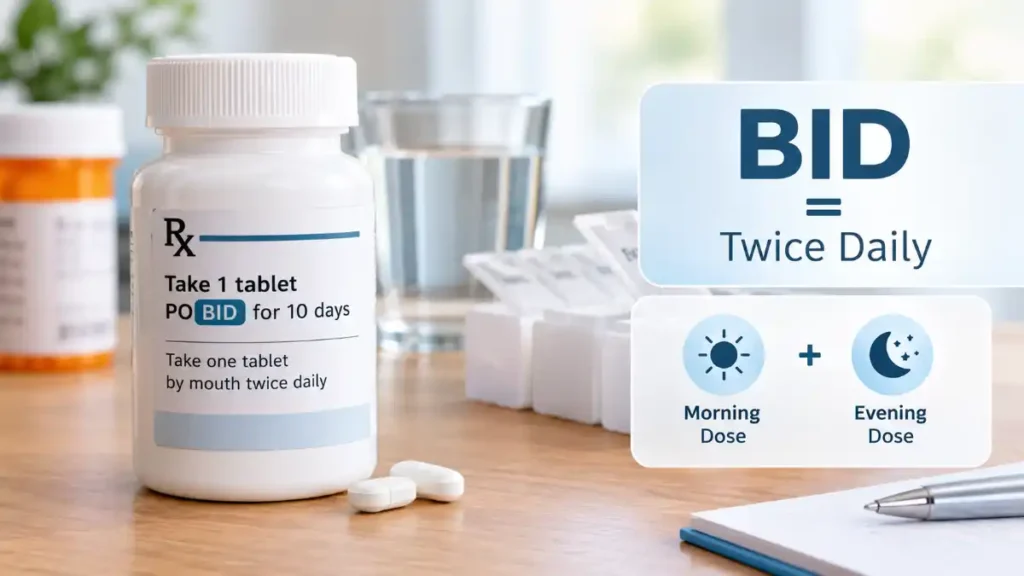
BID medical abbreviation means “twice a day” and comes from the Latin phrase bis in die. It appears on prescriptions, medication labels, and medical records to indicate that a medication should be taken or administered twice daily. For example, “Take 1 tablet PO BID” means taking one tablet by mouth twice a day, for a total of two tablets daily.
BID tells you how often to take a medication, not its strength, the number of tablets per dose, or how long treatment should continue. It also doesn’t necessarily mean taking doses exactly 12 hours apart. The correct schedule depends on the medication and your prescriber’s instructions.
What Does the BID Medical Abbreviation Mean on a Prescription?
When a doctor writes BID on a prescription, it means the prescribed dose should be taken twice daily. The amount you take each time is listed separately.
Consider these two examples:
- Take 1 tablet PO BID: Take one tablet by mouth twice daily, totaling two tablets per day.
- Take 2 tablets PO BID: Take two tablets by mouth twice daily, totaling four tablets per day.
In both instructions, PO means “by mouth,” while BID indicates how frequently the medication should be taken.
That’s an important distinction because BID doesn’t automatically mean two pills per day. The total depends on how many tablets are prescribed for each dose. The abbreviation itself only specifies frequency, as explained in the common medical abbreviations reference.
You’ll also see BID in medication administration records and clinical notes. Healthcare professionals use it to communicate how often a prescribed treatment should be administered.
Does BID Mean Every 12 Hours?
BID means twice daily, but it doesn’t always require doses to be exactly 12 hours apart. Some medications can be taken in the morning and evening as part of a routine. Others need more precise spacing to maintain appropriate medication levels.
For example, one possible twice-daily schedule is:
- First dose: 8:00 AM
- Second dose: 8:00 PM
These times provide a 12-hour interval, but they’re only an illustration, not a schedule that applies to every BID prescription.
The difference between BID and q12h matters. BID specifies two doses per day, whereas q12h explicitly means every 12 hours. Although the schedules may sometimes look identical, the instructions aren’t always interchangeable. Some medications even require specific intervals between twice-daily doses that differ from 12 hours.
Follow the timing printed on your prescription label rather than choosing your own schedule. If your medication must be taken with food, on an empty stomach, or at specific intervals, those directions take priority over a general morning-and-evening routine.
BID vs. TID, QID, and Other Prescription Abbreviations
Prescription abbreviations allow healthcare professionals to communicate medication instructions quickly. However, similar-looking abbreviations can mean very different things, so it’s important to understand what each one indicates.
| Abbreviation | Meaning | Example |
| QD | Once daily | One dose each day |
| BID | Twice daily | One dose in the morning and one in the evening |
| TID | Three times daily | Three doses throughout the day |
| QID | Four times daily | Four doses throughout the day |
| PRN | As needed | Take only when needed for the prescribed reason, within the stated limits |
| q12h | Every 12 hours | One dose at 8 AM and another at 8 PM |
BID, TID, and QID tell you how many times to take a medication each day. They don’t necessarily establish exact intervals between doses, which may need to be specified separately.
PRN is different because it means taking medication only when needed for a particular reason. The prescription should also explain any timing restrictions and maximum allowable dose.
Although QD means once daily, it is considered an error-prone abbreviation. The Joint Commission’s medication abbreviation requirements prohibit its use in applicable medication orders and documentation. Writing “daily” instead helps prevent confusion.
For patients and caregivers, the key is to read the complete prescription rather than interpret an abbreviation in isolation.
How to Use BID Medication Instructions Safely
Knowing that BID means twice daily is a good starting point, but taking medication safely also requires understanding the prescribed dose, timing, administration instructions, and treatment duration.
Check the Complete Prescription Instructions
Before taking a BID medication, check how much you’re supposed to take each time and whether there are any additional directions.
Some medications need to be taken with meals, while others should be taken without food. BID alone doesn’t tell you whether food is required. You’ll need to check the specific instructions for your medication.
Pay attention to abbreviations that look or sound similar, particularly BID and TID. Confusing twice-daily and three-times-daily instructions could result in taking too much or too little medication.
Writing “twice daily” instead of BID can make instructions easier to understand, especially when they’re handwritten or communicated between healthcare professionals and patients.
It’s also worth reviewing the recommended precautions for taking prescription medications, including checking the label and confirming anything you don’t understand before taking a dose.
What Happens If You Miss a BID Dose?
What you should do after missing a BID dose depends on the medication, how much time has passed, and when your next dose is scheduled.
With some medications, you may be able to take the missed dose when you remember. With others, you may need to skip it if your next scheduled dose is approaching. Certain medicines have more specific requirements.
Don’t automatically take two doses together to make up for one you missed. Doing so can increase the risk of side effects or other medication-related problems.
General guidance on missed or delayed medication doses emphasizes that the appropriate response depends on the medicine and individual circumstances.
Check your medication’s instructions or contact your pharmacist or prescriber if you’re unsure what to do. Avoid changing the prescribed schedule on your own.
When Should You Ask a Pharmacist?
Speak with a pharmacist or healthcare professional whenever your prescription contains an unfamiliar abbreviation, conflicting directions, or timing instructions you don’t fully understand.
You should also ask if you’re uncertain whether your doses need to be exactly 12 hours apart, whether food affects your medication, or how to manage a missed dose.
If you need prescription assistance outside regular business hours, finding a 24-hour pharmacy may help. Confirm that the pharmacy counter is open and a pharmacist is available before visiting.
Frequently Asked Questions
Can BID Be Used for Liquid Medications, Eye Drops, or Injections?
Yes. BID describes how often a medication should be administered, regardless of whether it’s a tablet, liquid, eye drop, injection, or another prescribed form.
The amount and method of administration depend on the medication. For example, a liquid prescription may specify a certain number of milliliters twice daily, while eye-drop instructions may specify a particular number of drops.
What Should I Do If My Prescription Label and Doctor’s Instructions Don’t Match?
Contact your pharmacist or prescriber before following conflicting directions. Explain exactly what your label says and what you were told during your appointment.
Don’t guess which instructions are correct or adjust the dose yourself. A healthcare professional can confirm the intended amount, frequency, and timing.